
Learning to skateboard is an exhilarating journey, filled with scraped knees, triumphant grinds, and the sheer joy of mastering new skills. The progression from simply rolling to executing complex maneuvers is a testament to dedication and practice. However, attempting tricks without a foundational understanding can lead to frustration and potential injury.
This guide is designed to provide a structured approach to learning skateboard tricks, outlining a logical sequence that builds upon fundamental abilities, ensuring a smoother and more rewarding learning curve for aspiring skaters of all ages. The path to becoming a proficient skateboarder isn’t about speed; it’s about building a solid base of control and confidence. By understanding the recommended order of learning tricks, you can systematically develop the muscle memory, balance, and technique required for more advanced maneuvers. This structured approach not only makes the learning process more efficient but also significantly reduces the risk of setbacks.
Key Takeaways
- A structured approach to learning skateboard tricks, starting with fundamentals, is crucial for progression and safety.
- Mastering balance and board control are prerequisites for attempting any tricks.
- The ollie is the cornerstone of most street and park skateboarding tricks.
- Progression typically moves from flatground tricks to manual variations, then to grinds, slides, and eventually flip tricks.
- Consistency, patience, and a willingness to fall are essential components of the learning process.
- Proper safety gear and understanding your physical limits are paramount.
- Many beginner progression guides also include kickturns, tic-tacs, and drop-ins before more technical obstacle tricks.

Credit: www.youtube.com
The Foundation: Mastering Balance And Board Control
Before you even think about popping an ollie or grinding a rail, you need to feel comfortable and in control on your skateboard. This stage is arguably the most important, as it underpins everything else you’ll learn. Without a solid foundation of balance and an intuitive understanding of how your board responds to your movements, attempting tricks will be a frustrating and potentially dangerous endeavor.
Finding Your Stance
The first step is determining whether you are regular (left foot forward) or goofy (right foot forward). There’s no right or wrong answer; it’s about what feels natural. A common way to figure this out is to have someone gently push you from behind. Whichever foot you instinctively step forward with to catch yourself is likely your front foot. Another method is to imagine sliding on a slippery floor, which foot would you put forward? Experiment on your board, standing still, and see which foot placement feels most stable.
Pushing And Cruising
Once you’ve identified your stance, the next step is to learn how to push effectively and cruise around. This involves:
-
- Pushing: Place your front foot on the bolts of the board. Use your back foot to push off the ground, gaining momentum. Once you’ve pushed, bring your back foot onto the tail of the board to balance.
- Balancing: Keep your knees bent and your weight centered over the board. Your arms can be used for balance, extending them out to the sides.
- Turning: To turn, gently lean your weight onto your toes (for a toe-side turn) or your heels (for a heel-side turn). This is known as carving. As you get more comfortable, you’ll develop a feel for how much pressure to apply for different turn radii.
- Stopping: The simplest way to stop is by dragging your back foot on the ground. More advanced stopping techniques, like the foot brake (pressing down on the tail with your back foot while rolling slightly) and powerslides, come later.
Riding On Different Surfaces
Practice riding on various smooth surfaces like concrete, asphalt, and even smooth wooden ramps. This helps you adapt to different textures and speeds. Avoid rough surfaces initially, as they can make controlling the board much harder and lead to unexpected stops.
Understanding how your board reacts to friction and unevenness is a key part of developing board control.
Early Beginner Skills To Learn Before Tricks
Many skaters benefit from learning a few simple control skills before focusing on ollies and grinds. Tic-tacs help you change direction without pushing, kickturns teach you to lift the front wheels and pivot, and rolling off small curbs or gentle ramps builds confidence for future obstacle work. These skills can make the transition to tricks much smoother and safer.
If you’re choosing your first setup, a standard complete skateboard with medium-soft wheels for rougher ground, medium-hard wheels for smoother skateparks, and trucks adjusted to your comfort level will usually make learning easier. Make sure the deck has fresh grip tape, the trucks are not so loose that the board feels unstable, and the wheels spin freely without obvious bearing issues.

Credit: www.youtube.com
The Gateway Trick: Mastering The Ollie
The ollie is the foundational trick in skateboarding. It’s the act of jumping into the air with your board still attached to your feet, without using your hands. Nearly every other trick, from flip tricks to grinds and airs, incorporates some variation of the ollie. Mastering this trick requires developing a specific sequence of movements and timing.
Understanding The Mechanics
An ollie involves a coordinated effort:
-
- The Pop: You start with your back foot on the tail of the board. A quick, sharp stomp, or “pop,” on the tail against the ground is the initial energy. This causes the tail to hit the ground and the board to spring upwards.
- The Slide: Simultaneously, as the tail hits the ground and the board begins to rise, you slide your front foot up the length of the board towards the nose. This motion is crucial for leveling out the board in the air.
- The Leveling: As your front foot reaches the nose, you slide it forward to keep the board level beneath you in mid-air. This action, combined with the upward momentum from the pop and the sliding motion, helps keep the board from tipping nose-down or tail-down.
- The Landing: As you descend, bring your knees up to absorb the impact and prepare for landing. Try to land with your feet over the bolts.
Practice Drills For The Ollie
-
- Stationary Ollies: Practice popping and sliding while stationary. Focus on getting the board to come up with you. Start by trying to get just a little pop, then gradually increase the height.
- Ollies While Rolling: Once you can ollie stationary, try doing it while rolling slowly. This adds the challenge of maintaining balance while initiating the pop.
- Ollie Over Obstacles: Begin with very small obstacles, like a crack in the pavement or a thin piece of tape on the ground. Gradually increase the height of the obstacle as your confidence and technique improve.
- Ollie Up Curbs: This is a great practical application of the ollie, teaching you to get onto ledges and higher surfaces.
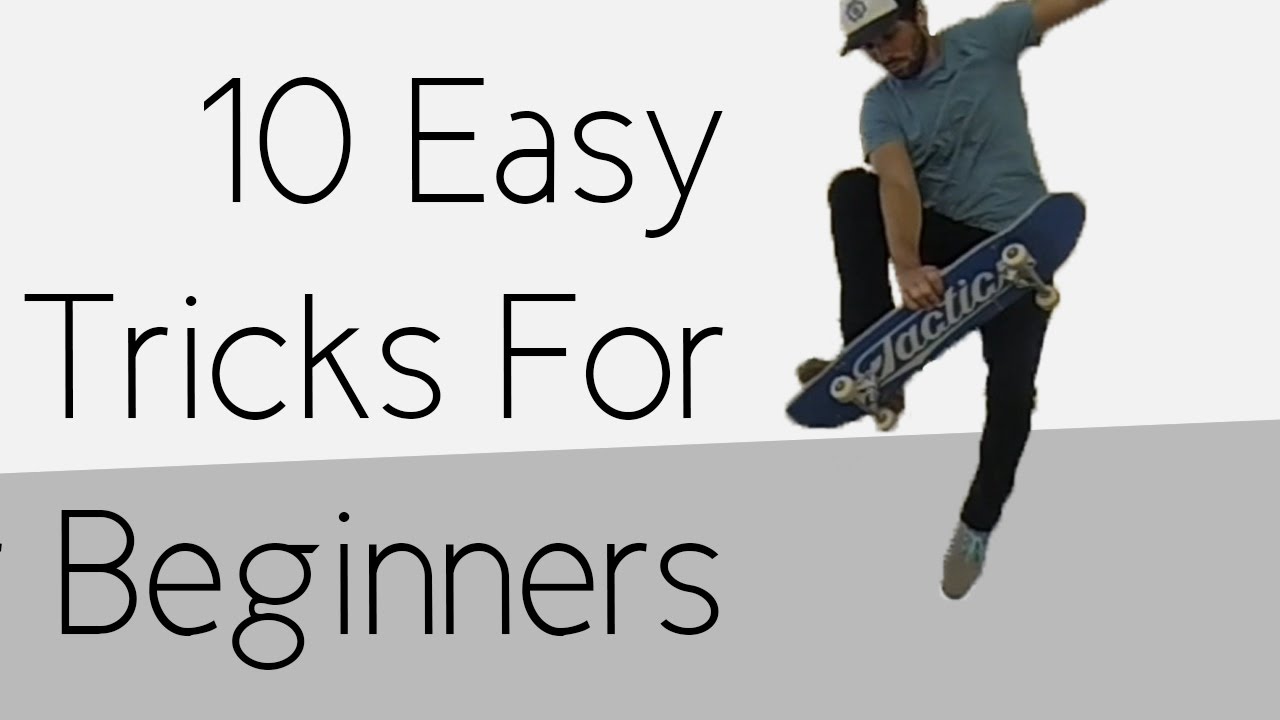
In my experience, the ollie is a hurdle many beginners struggle with. The key is not to force it but to be patient and consistent with practice. Many skaters find it helpful to focus on the pop first, then the slide, and then combine them.
For better results, start with a comfortable rolling speed instead of staying fully still, since many skaters find the ollie easier when the board is already moving. Keep your shoulders squared and avoid leaning too far forward, which can make the board shoot away from you.
Credit: www.youtube.com
Building On The Ollie: Flatground And Manual Tricks
With a solid ollie under your belt, you can begin to explore tricks that are performed on flat ground or involve balancing on two wheels. These tricks enhance your board control, timing, and ability to manipulate the board in motion.
Introduction To Manuals
A manual is essentially a wheelie on a skateboard. It involves balancing on the back two wheels while rolling.
-
- How to Manual: Start by rolling slowly. Place your back foot on the tail and your front foot near the front bolts. Gently lift the front wheels off the ground by applying pressure to the tail, and then adjust your weight to maintain balance on the back wheels. Keep your knees bent and your arms out for stability.
Tail Manuals
A tail manual is a variation of the manual where you balance on the tail of the board, with the front wheels lifted. This is often easier to learn than a standard manual for some skaters.
-
- How to Tail Manual: Roll slowly. Place your back foot firmly on the tail and your front foot in the middle of the board. Gently lift the nose of the board by applying pressure to the tail, and then find your balance point on the back two wheels.
Fakie Manuals And Nollies
Once you’re comfortable with manuals, you can try them in fakie (riding backward and popping/lifting with your front foot forward). A nollie is an ollie performed in fakie stance. These variations challenge your directional awareness and control.
Introduction To Flip Tricks (basic)
While advanced flip tricks are complex, understanding the fundamental mechanics of how to make the board flip is a good next step. This typically involves variations on the ollie where you use your feet to impart a rotation.
-
- The Kickflip: A basic flip trick where the board rotates 360 degrees along its long axis. It’s an ollie where your front foot slides up and off the side of the board, flicking it to make it spin.
- The Heelflip: The counterpart to the kickflip, where the board rotates in the opposite direction. This is achieved by flicking the board with your heel.
Learning these requires significant practice of the ollie and developing precise foot placement and flicking techniques. Many skaters find it beneficial to practice the flicking motion without even jumping first.
Grinds And Slides: Engaging With Obstacles
Once you’ve mastered flatground tricks and can ollie consistently, you’re ready to interact with the urban landscape and skatepark features. Grinds and slides involve riding along ledges, rails, and coping.
Essential Prep: Approach And Speed
Before attempting any grind or slide, you need to be comfortable approaching obstacles at a controlled speed.
-
- Speed Control: You need enough speed to clear the obstacle and ride away smoothly, but not so much that you lose control. Practice rolling up to ledges and rails at various speeds.
- Approach Angle: The angle at which you approach the obstacle is critical. For most grinds and slides, a slight angle is optimal to allow the board to lock into the grind or slide smoothly.
Basic Grinds
Grinds involve riding on the trucks of your skateboard.
-
- 50-50 Grind: The most fundamental grind. You approach a ledge or rail and ollie so that both of your trucks land on top of it. You then ride along the obstacle with both trucks grinding. The key is to get your trucks centered on the ledge/rail.
- 5-0 Grind (or 5-0): A grind performed on the back truck only. You ollie onto the ledge/rail so that only your back truck is on it, balancing on the rear truck with the front wheels in the air. This requires good balance, similar to a manual.
- Nosegrind: The opposite of a 5-0 grind, performed on the front truck only. You ollie onto the ledge/rail, balancing on the front truck with the back wheels in the air. This is generally more challenging than a 5-0 due to the board’s pivot point.
Basic Slides
Slides involve riding on the deck of your skateboard, typically on the bottom.
-
- Boardslide: You ollie over a rail or ledge and land with the middle of your board on top of the obstacle, so the rail/ledge is between your trucks. You then slide along the obstacle on the underside of your deck. This requires precise ollie timing and positioning.
- Lipslide: Similar to a boardslide, but you ollie and rotate your body and board slightly so that your back truck goes over the obstacle first, and then you land in a slide position with the middle of your board on the obstacle. This is generally considered more difficult than a boardslide.
Transitioning From Grinds/slides
Learning to get off the obstacle cleanly is as important as getting on. Practice riding away smoothly, maintaining balance, and preparing for your landing.
Use lower obstacles first, especially low ledges and beginner-friendly curbs, before moving to rails. A rail is less forgiving than a ledge and should be treated as an advanced progression step.
Intermediate Tricks: Expanding Your Repertoire
With a solid understanding of ollies, manuals, grinds, and basic slides, you’re ready to tackle more complex maneuvers that combine these elements or introduce new techniques. This stage is where you start to develop your personal style and push your limits.
Flip Trick Progression
Building on the kickflip and heelflip, you can learn more advanced flip tricks.
-
- Pop Shuvit: A trick where the board rotates 180 degrees horizontally beneath your feet, without flipping. You achieve this by scooping your back foot off the tail.
- Frontside 180 Ollie: An ollie where you and the board rotate 180 degrees in the frontside direction (facing the direction you are turning).
- Backside 180 Ollie: An ollie where you and the board rotate 180 degrees in the backside direction (turning away from the direction you are turning).
- Varial Kickflip: A combination of a kickflip and a pop shuvit, where the board rotates 180 degrees horizontally and flips once along its long axis.
- 360 Flip (Tre Flip): A highly popular and visually impressive trick combining a 360-degree pop shuvit rotation with a kickflip. This trick requires excellent board control and timing.
Grinds And Slides Variations
You can also learn more advanced variations of grinds and slides.
-
- Smith Grind: A grind on a ledge where your back truck grinds on the edge, and your front truck is positioned on top of the ledge.
- Feeble Grind: The opposite of a Smith grind, where your front truck grinds on the edge, and your back truck is positioned on top of the ledge.
- Bluntslide: A slide where you approach a ledge or rail, ollie, and land with your back truck on top of the ledge and your board sliding on its tail and the edge of the ledge.
- Crooked Grind: A grind on a ledge where your front truck grinds on the edge, but at a more extreme angle than a feeble grind, often appearing more “crooked.”
Introduction To Transition Skating
Transition skating involves riding in transition, curved surfaces like ramps, bowls, and half-pipes.
-
- Pumping: Learning to pump is essential for gaining speed in transition without having to push. It involves bending and extending your knees in rhythm with the curve of the ramp.
- Rock to Fakie: A basic transition trick where you ride up to the coping (the metal edge of a ramp), lift your front wheels, and “rock” onto the coping with your front truck, then ride back down fakie.
- Rock and Roll: Similar to rock to fakie, but after rocking onto the coping, you bring your back wheels up and roll back down into the ramp in your normal stance.
Transition skating also commonly begins with drop-ins, axle stalls, and rock-to-fakie before more complex lip tricks and airs.
Advanced Techniques And Putting It All Together
As you progress, you’ll find yourself combining tricks, developing your own lines through skateparks, and perhaps even venturing into more specialized areas like vert skating or street competitions. This stage is about creativity, flow, and pushing the boundaries of what you thought possible.
Combining Tricks And Lines
The true art of skateboarding often lies in linking multiple tricks together smoothly. This is often referred to as skating a line. For example, you might ollie onto a ledge, perform a 50-50 grind, ollie off, and land into a manual. Developing lines requires understanding the physics of your board, momentum, and how to transition between different types of maneuvers.
Vert Skating And Airs
Vert skating involves riding on vertical ramps (like half-pipes or full pipes).
-
- Airs: These are tricks performed while launching off the lip of a ramp into the air. They can range from simple ollies over the coping to complex grabs (holding the board with your hand while in the air) and rotations.
- Inverts: Tricks where you ride up the wall of a ramp and briefly balance or invert your body.
Street Skating And Technicality
Street skating focuses on using the urban environment, stairs, handrails, ledges, gaps, as obstacles.
-
- Gap Jumps: Ollies performed over gaps or spaces between obstacles.
- Stair Sets: Ollies or flip tricks performed down sets of stairs.
- Rail Grinds: Grinds performed on handrails, which are often more challenging than ledge grinds due to their shape and height.
Developing Your Style
Ultimately, the goal is to develop your own unique style. This is reflected in how you perform tricks, how you combine them, your board control, and your overall presence on the skateboard. Experimentation is key. Try tricks in different ways, learn from other skaters, and don’t be afraid to adapt tricks to your own strengths. The skateboarding culture is rich with diverse styles, from the technical precision of street skaters to the flowing lines of transition riders.
Safety And Mindset: Essential For Long-term Progression
Skateboarding is inherently risky, but with the right approach to safety and a positive mindset, you can minimize injuries and enjoy the sport for years to come.
Gear Up Properly
-
- Helmet: Non-negotiable. A certified skate helmet protects against serious head injuries.
- Pads: Knee pads, elbow pads, and wrist guards significantly reduce the severity of common skateboarding injuries.
- Shoes: Skate shoes offer good grip, board feel, and durability.
For more on essential gear, check out our guide on What to Wear for Skateboarding: Essential Gear and Style Tips.
Know Your Limits And Listen To Your Body
Don’t push yourself too hard, too fast. If you’re feeling fatigued or sore, take a break. Attempting tricks when you’re tired increases the likelihood of mistakes and injuries. Gradually increase the difficulty of tricks and the duration of your skating sessions.
The Importance Of Falling
Falling is an unavoidable part of skateboarding. Learning how to fall properly can save you from serious injury. Try to roll out of falls rather than bracing yourself rigidly. Relax your body and use your pads and helmet. Every fall is a learning opportunity.
Patience And Persistence
Learning skateboard tricks takes time, dedication, and a lot of repetition. There will be days when you feel like you’re not progressing, or even going backward. This is normal. The key is to stay persistent, celebrate small victories, and maintain a positive attitude. The mental benefits of skateboarding, such as increased confidence and resilience, are as significant as the physical ones. You can learn more about this in our article on Why Skateboarding is Good for Mental Health: Boost Your Wellbeing.
Frequently Asked Questions
What Is The Most Important Trick To Learn First?
The ollie is widely considered the most important trick to learn first. It’s the fundamental building block for almost all other skateboarding tricks, enabling you to jump, clear obstacles, and get onto ledges. Without a solid ollie, progressing to more advanced maneuvers becomes extremely difficult.
How Long Does It Take To Learn The Basic Skateboard Tricks?
The timeline for learning basic skateboard tricks varies greatly depending on individual dedication, practice frequency, natural aptitude, and age. Learning to simply ride comfortably and do a basic ollie might take anywhere from a few weeks to a few months of consistent practice.
More complex tricks like kickflips can take significantly longer, often many months or even years of dedicated effort.
Should I Learn Tricks On A Flat Ground Or In A Skatepark?
It’s best to start with flat ground basics like pushing, balancing, and the ollie. Once you can reliably ollie, you can then move to a skatepark to practice grinds, slides, and transition tricks on designated features. Skateparks offer a controlled environment for practicing these maneuvers, but having a solid flat ground foundation is crucial for safety and success.
What Are The Common Mistakes Beginners Make When Learning Tricks?
Common mistakes include not bending their knees enough, having improper foot placement, trying to learn tricks too advanced for their current skill level, not practicing consistently, and being afraid to fall. Another frequent error is neglecting the fundamental ollie, which leads to instability when attempting other tricks.
Learning to fall correctly is also often overlooked, leading to more severe injuries.
How Can I Improve My Balance On A Skateboard?
Improving balance comes from consistent practice. Spend more time simply riding your board, focusing on keeping your knees bent and your weight centered. Practice stationary balancing, manuals, and nose manuals. Riding on different surfaces and gradually increasing your speed will also help you adapt and improve your overall balance and control.
Learning skateboard tricks is a progressive journey, best approached with patience, persistence, and a focus on building a strong foundation. By understanding the order of progression, from mastering balance and the ollie to exploring grinds, slides, and flip tricks, you can create a clear path for improvement.
Remember to prioritize safety, embrace the learning process, and enjoy the ride.