How Do I Choose a Skateboard for an Adult Beginner
Choosing your first skateboard as an adult can feel like navigating a maze. The sheer variety of shapes, sizes, and components can be overwhelming, especially when you’re eager to hit the pavement and start cruising or learning tricks. Unlike buying a pre-assembled toy, a skateboard is a finely tuned piece of equipment where each part plays a crucial role in your riding experience.
Getting it right from the start not only makes learning easier and more enjoyable but also ensures safety and longevity.
This guide is designed to demystify the process. We’ll break down each component, explain the different types of skateboards available, and offer practical advice to help you select the perfect board for your needs and goals. Whether you dream of carving smooth lines at a skatepark, commuting around town, or mastering your first ollie, understanding the fundamentals of skateboard selection is your first step toward a rewarding skateboarding journey.
Key Takeaways
- Beginner Boards are Key: Opt for a complete skateboard designed for beginners, offering a balanced setup for learning.
- Deck Size Matters: Choose a deck width that comfortably fits your shoe size and riding style, typically between 7.75 and 8.5 inches for adults.
- Wheel Hardness and Size: Softer, larger wheels are better for cruising and rough surfaces, while harder, smaller wheels are suited for tricks and smooth parks.
- Trucks and Bearings: Ensure trucks are proportional to your deck width and that bearings are at least ABEC 5 or higher for smooth rolling.
- Safety First: Always invest in protective gear like a helmet, knee pads, elbow pads, and wrist guards.
- Consider Your Goals: Decide if you want to cruise, commute, or learn tricks, as this will influence your board choice.
- Budget Wisely: While budget boards exist, investing a bit more in a reputable brand can offer better quality and durability.
Understanding Skateboard Components
A skateboard isn’t just a plank of wood with wheels. It’s a carefully engineered assembly of several key parts, each contributing to its performance and feel. Understanding these components is fundamental to making an informed choice.
The Deck
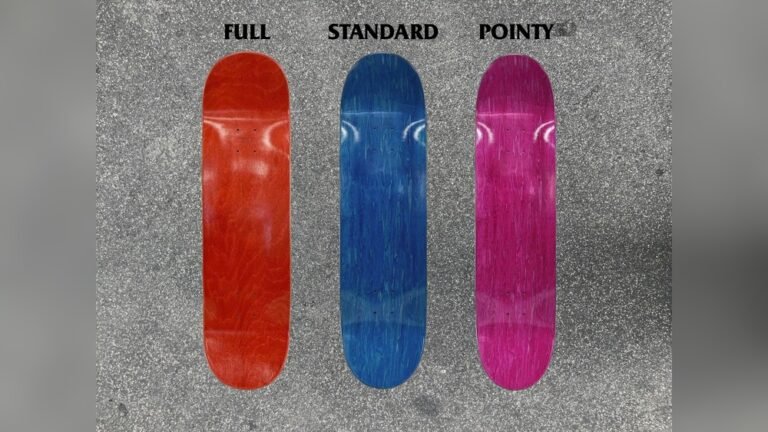
The deck is the wooden board you stand on. It’s typically made from 7 to 9 plies of maple wood, pressed together and shaped. Decks come in various widths, lengths, and concaves (the curvature across the width).
- Width: This is arguably the most critical measurement for beginners. A wider deck offers more stability, while a narrower deck is lighter and easier to flip for tricks. For adult beginners, a deck width between 7.75 inches and 8.5 inches is generally recommended. Larger shoe sizes often benefit from wider decks (8.25 inches and up) for better foot placement and control.
- Length: While less critical than width for beginners, deck length also influences stability and maneuverability. Most standard decks range from 31 to 33 inches in length.
- Concave: This refers to the side-to-side curve of the deck. Common concaves include mellow, medium, and deep. A medium concave offers a good balance of comfort and board feel, making it suitable for most beginners. A deeper concave can provide more leverage for flicking tricks but might feel less comfortable for cruising.
- Material: While maple is the standard, some decks incorporate composite materials for added strength or lightness. For a beginner, a solid maple deck is the most reliable and common choice.
Trucks
Trucks are the T-shaped metal axles mounted to the underside of the deck. They hold the wheels and allow you to steer by leaning.
- Width: Truck width should generally match the width of your deck. The axle (the kingpin-to-kingpin distance) should be close to the deck’s width. If the trucks are too narrow, the board will be unstable; if they’re too wide, it will be harder to turn. Many truck manufacturers list recommended deck sizes for their truck widths.
- Height: Trucks come in low, mid, and high profiles. Low trucks are closer to the ground, offering more stability and easier board control for flip tricks. High trucks provide more clearance for larger wheels, reducing the risk of “wheel bite” (when the wheel touches the deck during a turn, stopping you abruptly), and can offer a more responsive turning feel. For beginners, mid-height trucks are often a good all-around choice.
- Bushings: These are the rubbery parts within the truck that control how easily the truck turns. They come in various hardnesses. Softer bushings make turning easier but can be less stable at speed. Harder bushings offer more stability but require more effort to turn. Most complete skateboards come with standard bushings that are suitable for beginners. You can always replace them later to customize the feel.
Wheels
Skateboard wheels vary significantly in size and hardness, impacting ride quality and suitability for different terrains and styles.
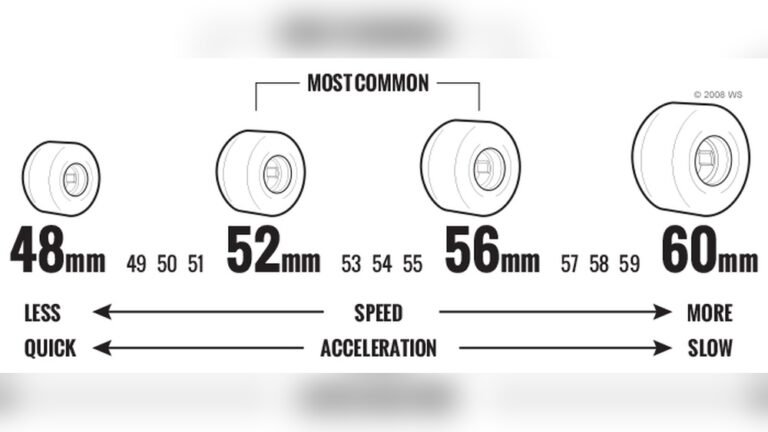
- Diameter (Size): Measured in millimeters (mm), wheel diameter affects speed and acceleration.
- Small wheels (50-54mm): Lighter, accelerate faster, and are ideal for technical street skating and skateparks where quickness is key. They are less suited for rough surfaces.
- Medium wheels (54-58mm): A good all-around size for street and park skating, offering a balance of speed and acceleration.
- Large wheels (58mm+): Roll faster, maintain speed better, and absorb vibrations from rough surfaces more effectively. These are excellent for cruising, commuting, and rougher terrain. For adult beginners focusing on comfortable riding and learning the basics, wheels in the 54mm to 60mm range are often ideal.
- Durometer (Hardness): Measured on the “A” scale (e.g., 99A, 101A), wheel hardness determines grip and smoothness.
- Softer wheels (78A-90A): Offer more grip, a smoother ride on rough surfaces, and are quieter. Great for cruising and commuting.
- Medium wheels (90A-99A): A compromise between grip and slide. Suitable for various surfaces.
- Harder wheels (99A-101A): Slide easier, are faster on smooth surfaces, and are preferred for skateparks and street skating. They can be noisy and bumpy on rough ground.
For adult beginners, especially those not immediately focused on technical tricks, softer wheels (around 78A-90A) will provide a much more comfortable and forgiving ride, making learning to balance and push easier. If you plan to skate primarily in skateparks, harder wheels (99A) might be better, but they will be less forgiving on uneven sidewalks.
Bearings
Bearings are the small, circular metal components that fit inside the wheels, allowing them to spin smoothly on the truck’s axle. They are rated using the ABEC scale (e.g., ABEC 3, ABEC 5, ABEC 7), which indicates precision.
- ABEC Rating: While higher ABEC ratings suggest greater precision, for skateboarding, the ABEC rating isn’t the most important factor. Durability and resistance to dirt and impact are often more critical. Most reputable skateboard brands use bearings that are at least ABEC 5 or higher, which are perfectly adequate for beginners.
- Maintenance: Bearings can get dirty and lose their speed. Regular cleaning and lubrication can extend their lifespan and performance. Many beginner complete skateboards come with decent bearings, but upgrading to higher-quality ones is a common step for riders looking for more speed and smoothness.
Griptape
Griptape is the sandpaper-like material applied to the top of the deck, providing traction for your feet. It’s essential for keeping your feet from slipping off the board. Most complete skateboards come with pre-applied griptape. You can buy sheets of griptape to replace it when it wears out or to customize its application.
Hardware And Risers
- Hardware: These are the nuts and bolts that attach the trucks to the deck. They come in different lengths (e.g., 7/8 inch, 1 inch). Longer hardware is needed if you use riser pads.
- Riser Pads: These are plastic pads placed between the trucks and the deck. They increase the distance between the deck and the wheels, helping to prevent wheel bite, especially when using larger wheels or looser trucks. Beginners might benefit from a small riser pad (e.g., 1/8 inch) for added clearance and a slightly more stable ride.
Types Of Skateboards For Adult Beginners
When you’re starting, the easiest path is often a complete skateboard. These are pre-assembled boards sold by manufacturers, offering a balanced setup suitable for general riding. However, understanding the different styles of skateboards can help you choose the right type of complete.
Traditional Skateboards (street/park)
This is what most people picture when they think of a skateboard: a symmetrical or near-symmetrical deck with a kicktail (and often a kicknose) for performing tricks.
- Design: Typically 7.75 to 8.5 inches wide, with a concave shape. The kicktail and nose allow for popping the board off the ground and performing tricks like ollies, kickflips, and grinds.
- Best For: Learning fundamental skateboarding skills, street skating (ledges, stairs, rails), and skatepark riding.
- Beginner Suitability: Excellent choice for adult beginners who are interested in learning tricks and riding in skateparks or urban environments. The stability and maneuverability are well-suited for developing balance and control.
Cruisers
Cruiser skateboards are designed for transportation and relaxed riding. They often resemble old-school skateboards or mini-longboards.
- Design: Usually feature a wider, often shorter deck than a traditional skateboard, with a more mellow concave or no concave at all. They typically come with larger, softer wheels for a smooth ride over various surfaces. Some may have a kicktail for basic maneuverability.
- Best For: Commuting, cruising around town, getting from point A to point B comfortably, and enjoying smooth, stable rides.
- Beginner Suitability: A fantastic option for adult beginners who prioritize a comfortable ride and want to use their skateboard for transportation rather than tricks. The larger wheels and softer durometer make them forgiving on cracks and pebbles, and the wider deck offers stability.
Longboards
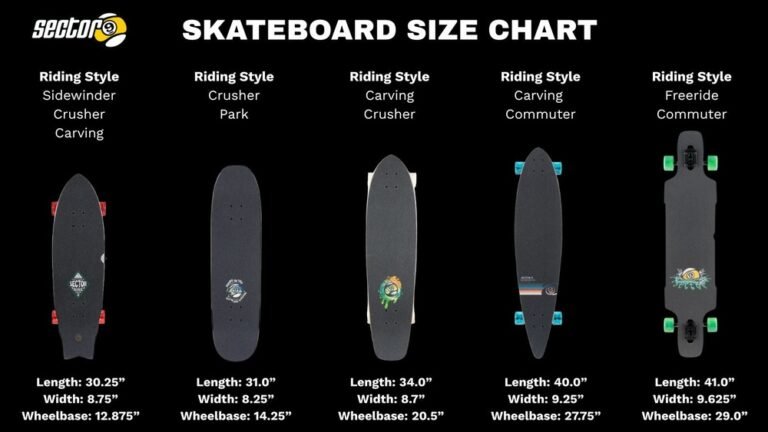
Longboards are significantly longer and wider than traditional skateboards, designed primarily for speed, downhill riding, and carving.
- Design: Decks can range from 35 to 45 inches or more in length and are often wider. They come in various shapes (pintail, drop-through, symmetrical) and have different flex characteristics. They typically use larger, softer wheels for speed and stability.
- Best For: Downhill riding, long-distance commuting, carving smooth, deep turns, and a very stable riding experience.
- Beginner Suitability: While longboards offer excellent stability, they are less suited for learning traditional skateboarding tricks due to their size and weight. If your primary goal is cruising long distances or downhill, a longboard is ideal. For general adult beginners aiming for a mix of cruising and potential trick learning, a traditional skateboard or a cruiser is often a better starting point. For a comprehensive overview of longboards, explore the History of Longboarding.
Hybrid/all-terrain Boards
These boards aim to blend features from different styles, offering versatility.
- Design: Can range from slightly wider street decks with larger wheels to smaller longboard-style decks. They are often designed to handle a mix of surfaces.
- Best For: Riders who want a board that can handle both smooth pavement and slightly rougher terrain, or a board that can do a bit of everything.
- Beginner Suitability: Can be a good option if you’re unsure of your exact riding style, but ensure the components are well-balanced. A hybrid might lean more towards cruising with larger wheels or more towards tricks with a narrower deck.

Credit: luckyskates.com.au
How To Choose The Right Size Skateboard
Selecting the correct size skateboard is crucial for comfort, control, and safety, especially for adult beginners. The primary measurement to focus on is the deck width.
Deck Width Guide For Adults
The width of the deck is measured across its widest point. While personal preference plays a role, here’s a general guideline for adult beginners:
- 7.5″ – 7.75″: Generally considered small for adults. Better suited for younger riders or smaller adults with smaller shoe sizes (US Men’s 7 and below).
- 7.75″ – 8.25″: A popular range for many adult beginners. This offers a good balance of stability and maneuverability. If you have average-sized feet (US Men’s 7-10), this range is a solid starting point.
- 8.25″ – 8.75″: Wider decks provide more stability and a larger platform for your feet. This is often recommended for adults with larger shoe sizes (US Men’s 10 and up) or those who prioritize stability for cruising and learning balance.
- 8.75″+: Very wide decks, often found on longboards or specialized setups. Generally too wide for a beginner learning street or park skating.
Pro Tip: A good way to gauge the right width is to stand on a board and see how your feet fit. Your feet should comfortably fit on the deck without hanging off too much, but not be so far in that you feel cramped. Your shoe size is a strong indicator.
Deck Length And Wheelbase
While width is paramount, length and wheelbase also contribute to the feel.
- Length: Most standard street decks are between 31 and 33 inches long. Longer decks offer more stability at speed, while shorter decks can feel more nimble. For beginners, this difference is less critical than width.
- Wheelbase: This is the distance between the inner mounting holes for the trucks. A longer wheelbase generally means more stability and a wider turning radius, while a shorter wheelbase offers quicker turns and a more responsive feel. Most complete skateboards have a wheelbase that is proportional to the deck length and width.
Truck And Wheel Sizing Considerations
- Trucks: As mentioned earlier, truck width should ideally match your deck width. For example, an 8.0-inch wide deck would typically pair with 8.0-inch trucks (axle width). Reputable brands make this easy by specifying which deck sizes their trucks are designed for.
- Wheels: For street and park skating, 50-54mm wheels are common. For cruising and a more forgiving ride, 54-60mm wheels are excellent. If you choose larger wheels (above 56mm), you might need riser pads to prevent wheel bite, especially with lower or mid-profile trucks.
Example: An adult beginner with a US Men’s shoe size 9 might find an 8.0-inch wide deck with 54mm, 99A wheels and mid-height trucks to be a versatile and comfortable setup for learning the basics. If they primarily want to cruise, they might opt for an 8.25-inch deck with 58mm, 78A wheels.
Complete Skateboards Vs. Custom Builds
For a beginner, the choice often comes down to buying a complete skateboard or building a custom setup piece by piece.
Complete Skateboards
These are factory-assembled skateboards sold as a single unit. They are convenient, often more affordable, and designed to offer a balanced riding experience.
- Pros:
- Convenience: Ready to ride right out of the box.
- Affordability: Generally less expensive than buying individual components.
- Balanced Setup: Manufacturers aim to create a cohesive setup that works well for general riding.
- Great for Beginners: Ideal for those who don’t know their preferences yet.
- Cons:
- Component Quality: Components (especially wheels and bearings) might be lower quality on very cheap completes.
- Limited Customization: You get what the manufacturer puts together.
- Potential for Mismatched Parts: Very low-end completes might have components that aren’t optimally sized.
Reputable Brands: Many established skateboard companies offer excellent complete skateboards. Brands like Element, Santa Cruz, and Powell-Peralta are known for producing quality completes suitable for beginners. For instance, Element Skateboards often provide well-balanced beginner setups. Similarly, Santa Cruz Skateboards offer reliable options.
Custom Builds
This involves selecting each component individually: deck, trucks, wheels, bearings, griptape, and hardware.
- Pros:
- Full Customization: You choose every part to match your exact preferences and riding style.
- Higher Quality Components: You can select premium parts for better performance and durability.
- Deeper Understanding: Building your own board teaches you a lot about its mechanics.
- Cons:
- More Expensive: Individual components usually add up to a higher overall cost.
- Requires Knowledge: You need to understand how different parts work together.
- Time-Consuming: Researching and assembling takes time.
When to Consider a Custom Build: As a complete beginner, a custom build might be overkill. However, if you’ve skated before or have a very specific idea of what you want (e.g., a particular deck shape, specific wheel size for cruising), it can be rewarding. You can also upgrade components on a complete board over time. For insights into manufacturing quality, check out our Skateboard Manufacturers Guide.
Recommendation for Beginners: Start with a reputable complete skateboard. This provides a good foundation and allows you to experience different aspects of riding. As you progress and discover your preferences, you can then consider building a custom board or upgrading individual parts.
Wheels: The Key To A Comfortable Ride
The wheels are your connection to the ground, and their characteristics significantly influence how your skateboard feels and performs, especially for adult beginners. Two main factors define wheels: diameter and durometer (hardness).
Wheel Diameter
Wheel diameter, measured in millimeters (mm), dictates how quickly the board accelerates and how fast it can reach its top speed.
- Small Wheels (50-53mm): These are lightweight and accelerate quickly. They are favored by street skaters for their responsiveness and lower profile, which reduces the chance of wheel bite during tricks. However, they don’t roll over cracks and debris as easily and can feel slower on rough surfaces.
- Medium Wheels (54-58mm): This is a versatile range. They offer a good balance between quick acceleration and maintaining speed. They are a popular choice for a wide variety of skating, from street to skateparks.
- Large Wheels (59mm+): These wheels have a larger rolling surface, allowing them to maintain speed longer and roll over obstacles more smoothly. They are ideal for cruising, commuting, and rougher terrain. They are slower to accelerate but reach higher top speeds and provide a smoother ride.
For Adult Beginners: If your primary goal is to cruise around, commute, or simply get comfortable balancing and pushing, larger wheels (56mm-60mm) are highly recommended. Their ability to absorb vibrations and roll over imperfections will make your experience much more enjoyable and less jarring. If you are focused on learning tricks in a skatepark from day one, smaller to medium wheels (52mm-56mm) might be considered, but be prepared for a bumpier ride on less-than-perfect surfaces.
Wheel Durometer (hardness)
Wheel durometer is measured on the “A” scale, with higher numbers indicating harder wheels.
- Soft Wheels (78A-90A): These wheels offer excellent grip, absorb shock well, and provide a quiet, smooth ride. They are perfect for rough pavement, cruising, and commuting. Their high grip means they are less likely to slide, which can be beneficial for stability but makes certain tricks (like powerslides) harder.
- Medium Wheels (90A-99A): This range offers a compromise. They are harder than soft wheels, providing a bit more speed and a slightly less smooth ride, but still offer decent grip.
- Hard Wheels (99A-101A): These are the standard for most street and park skaters. They are fast on smooth surfaces, slide easily for tricks, and are very durable. However, they transmit vibrations from rough surfaces directly to your feet, making for a bumpy and noisy ride on anything but pristine pavement.
For Adult Beginners: For a comfortable and forgiving introduction to skateboarding, softer wheels (78A-90A) are almost always the best choice. They make riding on varied surfaces much more pleasant and help build confidence by providing a stable, grippy platform. If you’re aiming for a hybrid approach, consider wheels around 90A-95A. If you’re committed to the skatepark and tricks