
The thrill of cycling, the freedom of the open road, the wind in your hair—it’s an experience many cherish. Equally, the exhilarating world of skateboarding offers a unique blend of skill, creativity, and urban exploration. Both activities are fantastic forms of exercise and recreation, often involving helmets for safety. However, a crucial question arises for those participating in both: can you swap your skate helmet for a cycling helmet, or vice versa? Understanding the distinct safety standards and design philosophies behind these protective gears is paramount.
While both skateboards and bicycles can lead to falls and head impacts, the nature of these impacts can differ significantly. Skateboarding often involves lower-speed falls but potentially more varied and rotational impacts, especially on hard, unforgiving surfaces. Cycling, on the other hand, can involve higher speeds and more direct, linear impacts, particularly in collisions or crashes with vehicles. This fundamental difference in risk profile necessitates specialized protective equipment for each activity.
Key Takeaways
- Different Standards, Different Designs: Skate helmets and cycling helmets are designed and certified to meet different safety standards, reflecting the distinct risks associated with each activity.
- Skate Helmets for Skateboarding: Skate helmets are typically designed to withstand multiple, lower-energy impacts and often cover more of the head, including the back and sides.
- Cycling Helmets for Cycling: Cycling helmets prioritize ventilation and aerodynamics for higher speeds, and are engineered to protect against single, higher-energy linear impacts.
- Certification is Crucial: Look for specific certifications (e.g., CPSC for cycling, ASTM for skate) to ensure a helmet meets the required safety benchmarks for its intended use.
- Cross-Use is Risky: Using a skate helmet for cycling, or a cycling helmet for skateboarding, compromises safety as they are not built to protect against the specific types of impacts common in the other sport.
- Fit and Comfort Matter: Regardless of the sport, a properly fitting helmet is essential for effective protection and comfort.
- Check for Dual Certification: Some helmets are certified for both cycling and skateboarding, but you should only rely on them if the labels inside clearly list both relevant standards.

Credit: rideabikeright.com.au
Understanding Helmet Safety Standards
The core of the debate about using a skate helmet for cycling, or vice versa, lies in the safety standards they are designed to meet. These standards are not arbitrary; they are developed through extensive research into the physics of impact and the biomechanics of head injuries. Different sports present unique risks, and helmet manufacturers create products that adhere to specific regulations to mitigate those risks effectively.
The Role Of Certification Bodies
Various organizations worldwide are responsible for setting and testing helmet safety standards. For cycling helmets in the United States, the most critical standard is set by the Consumer Product Safety Commission (CPSC). Helmets certified under CPSC must meet requirements for impact absorption, coverage, strap strength, and positional stability relevant to cycling accidents.
For skateboarding, and often for related activities like rollerblading and scootering, ASTM International sets the benchmarks. The ASTM F1492 standard is commonly applied to skate helmets. It includes performance requirements and test procedures that address skateboarding and trick roller skating impacts, including different impact sites and hazard shapes.
Some helmets on the market are sold as multi-sport or dual-certified models. These can be a practical option for people who regularly cycle and skate, but only if the helmet explicitly lists both the bicycle and skate standards on the certification label inside the helmet.
Key Differences In Testing Protocols
The testing protocols for CPSC and ASTM F1492 highlight the fundamental design differences.
-
- CPSC (Cycling): Focuses on a single, high-energy impact test. The helmet is dropped onto an anvil from a specific height, simulating a forceful impact. The foam liner is designed to crush and deform to absorb this energy, protecting the wearer from a severe blow. Ventilation and weight are also key considerations for cycling.
- ASTM F1492 (Skateboarding): Focuses on performance for skateboarding and trick roller skating, including impact tests at different sites and against different anvil shapes. This standard is intended for repeated lower-energy impacts and broader coverage needs common in skateboarding falls.
This distinction is crucial: a helmet optimized for a single, high-energy impact might not offer adequate protection against multiple or differently angled impacts, and vice versa.
Skate Helmet Design And Protection
Skate helmets are engineered with a specific set of risks in mind, primarily those encountered during skateboarding. These risks often involve falls from standing height or during tricks, leading to impacts on hard surfaces like concrete or asphalt.
Multi-impact Resistance
One of the defining features of many skate helmets is their ability to withstand multiple impacts. Unlike cycling helmets, which are generally designed to be replaced after a single significant impact, skate helmets often utilize materials and construction methods that allow them to absorb energy from several smaller bumps and falls. This is particularly relevant for skateboarders who might fall multiple times during a single session. This multi-impact capability doesn’t mean they are indestructible; a severe impact will still compromise their integrity.
Coverage And Shape
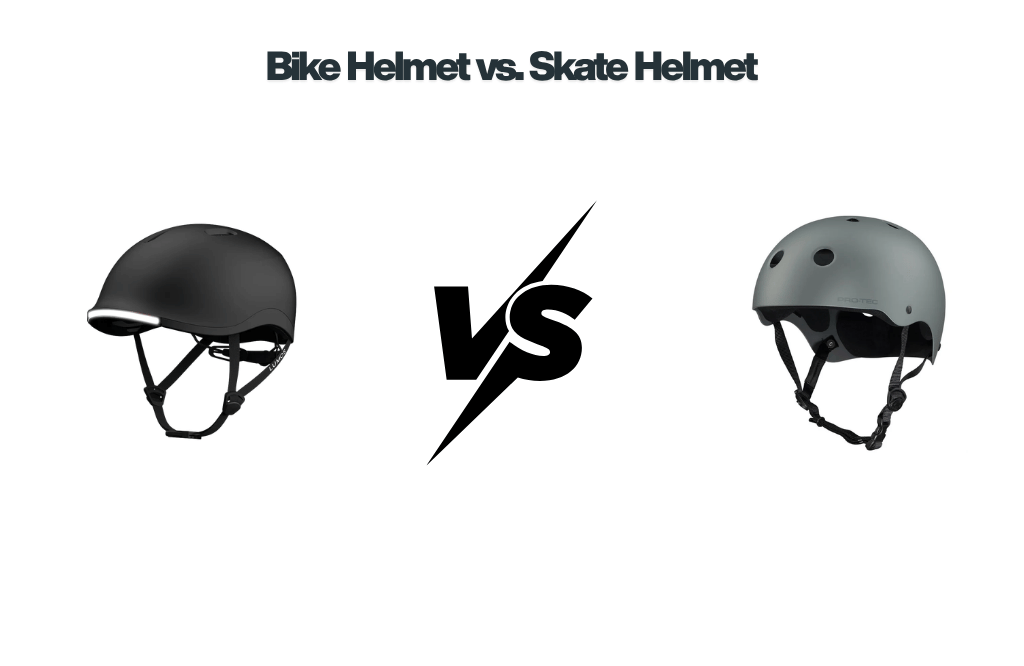
Skate helmets typically offer more coverage than their cycling counterparts. They often feature a lower profile at the back of the head and extend further down the sides. This enhanced coverage is designed to protect the occipital lobe and temporal regions of the skull, areas frequently impacted during skateboarding falls. The rounder, fuller shape also contributes to their ability to handle angled impacts more effectively.
Ventilation Vs. Durability
While ventilation is a significant factor in cycling helmet design for comfort at higher speeds, skate helmets often prioritize durability and coverage over maximum airflow. This can result in skate helmets feeling warmer and heavier than cycling helmets, especially during strenuous activity.
The trade-off is a more robust protective shell and liner system.
Aesthetics And Style
Skate helmets often embrace a distinct aesthetic that aligns with skateboarding culture. They tend to be more minimalist in design, often featuring a classic “skate” shape. Brands like Bern, Triple Eight, and Pro-Tec are well-known for their popular skate helmet models. These helmets are also often chosen for their style and how they complement skateboarding attire, as seen in discussions about what to wear for skateboarding.

Credit: www.reddit.com
Cycling Helmet Design And Protection
Cycling helmets are meticulously designed to address the unique hazards of riding a bicycle, which often involve higher speeds and different types of impacts compared to skateboarding.
Single-impact Energy Absorption
The primary design goal of a cycling helmet is to absorb the energy of a single, significant impact. The CPSC certification, for example, requires the helmet’s liner to manage crash energy during a fall or collision. Manufacturers strongly advise replacing a cycling helmet after any crash, even if no visible damage is apparent, because the protective capacity may be compromised.
Ventilation And Aerodynamics
At the higher speeds typical of cycling, ventilation is paramount for rider comfort and performance. Cycling helmets are designed with numerous vents to allow airflow over the head, helping to regulate body temperature. This airflow also contributes to aerodynamics, reducing drag and improving efficiency for road cyclists and racers. The shape of cycling helmets is often more elongated and sculpted to channel air smoothly over the rider’s head.
Lightweight Construction
To maximize comfort and performance, cycling helmets are generally designed to be as lightweight as possible. This is achieved through the use of advanced materials and a focus on minimizing the amount of foam and shell material while still meeting safety standards. This lightweight nature makes them more comfortable for long rides.
Integrated Features
Many modern cycling helmets come with integrated features such as adjustable retention systems (dials at the back for a snug fit), built-in visors (often removable), and mounting points for lights or cameras. Some models also incorporate rotational-impact technologies such as MIPS, which is designed to help reduce rotational motion during certain angled impacts.
Credit: ridelumos.com
Can You Use A Skate Helmet For Cycling?
The question of whether a skate helmet can be used for cycling is a common one, often driven by convenience or cost-saving. However, the answer, from a safety perspective, is generally no unless the helmet is specifically certified for bicycling. A skate-style shape alone does not make it safe for cycling.
Mismatched Safety Standards
As discussed, some skate helmets are certified only to ASTM F1492, which is intended for skateboarding and trick roller skating. Cycling helmets are typically certified to CPSC standards, which are optimized for bicycle crash conditions.
Using a skate helmet for cycling means you may be relying on a helmet that hasn’t been tested for the specific impact scenarios that cyclists face. The foam density, liner thickness, and shell construction of a skate helmet might not adequately absorb the forces from a high-speed cycling crash.
Some helmets sold as skate-style models are actually bicycle helmets with a skate-like look, so the label inside the helmet matters more than the exterior shape.
Potential Gaps In Protection
-
- Impact Energy: A skate helmet might not be engineered to withstand the higher energy impacts that can occur in a cycling crash.
- Impact Location: While skate helmets cover more area, the critical impact zones and velocities tested for cycling certification are different. A skate helmet might not perform optimally in a direct frontal impact at cycling speeds.
- Ventilation and Comfort: Skate helmets are often less ventilated, leading to overheating during cycling, which can affect performance and comfort.
When Might It Be “better Than Nothing”?
In a situation where no other helmet is available, wearing a helmet that is actually certified for your activity is best. If the only option available is a skate helmet that is not bicycle-certified, it may offer some protection compared with no helmet at all, but it should be treated as a temporary last resort rather than an acceptable long-term choice. The protection offered is not equivalent to a CPSC-certified cycling helmet.
Can You Use A Cycling Helmet For Skateboarding?
Conversely, the question arises: can a cycling helmet be used for skateboarding? Again, the safest answer is generally no unless it is specifically certified for skate use.
Designed For Different Impacts
Cycling helmets are primarily designed to protect against single, linear impacts. Skateboarding, however, often involves falls that can result in repeated impacts, as well as angled impacts. The EPS liner in a cycling helmet is engineered to crush and absorb energy from one major event.
After such an event, its protective capabilities are significantly reduced, and it needs replacement. Skateboarding falls are more frequent and often less severe individually, but the cumulative effect and the possibility of angled impacts are where skate helmets excel with their broader coverage and skate-specific certification.
Durability And Coverage Limitations
-
- Multi-Impact Capability: Cycling helmets generally lack the multi-impact resistance of skate helmets. Repeated minor impacts can compromise a cycling helmet’s integrity over time.
- Coverage: Cycling helmets often have less coverage at the back and sides of the head. These areas are more frequently impacted in skateboarding falls, and a cycling helmet might leave them inadequately protected.
- Shell Material: The outer shell of a cycling helmet is often thinner and made to save weight and improve airflow. That design can be less forgiving on abrasive surfaces commonly encountered in skateboarding.
Specific Skateboarding Scenarios
For disciplines like vert skateboarding or downhill skateboarding, where speeds can be higher and impacts more forceful, the distinction becomes even more critical. A dedicated skate helmet is the safer choice unless a helmet is explicitly dual-certified for both uses.
Helmets: A Comparative Look
To better illustrate the differences, let’s compare key features of typical skate and cycling helmets.
| Feature | Typical Skate Helmet | Typical Cycling Helmet |
|---|---|---|
| Primary Standard | ASTM F1492 (Skate focus) | CPSC (Cycling focus) |
| Impact Type | Repeated lower-energy impacts, varied angles | Single higher-energy impact |
| Coverage | More coverage at back and sides of head | Less coverage at back and sides, more ventilation space |
| Liner | Designed for repeated impacts and skate use | Designed to crush and absorb energy from a single major impact |
| Shell | Typically thicker, more durable | Typically lighter, more vented |
| Ventilation | Minimal to moderate | Extensive vents for airflow |
| Weight | Generally heavier | Generally lighter |
| Replacement | Replace after significant impact or if damaged | Replace after any crash or significant impact |
| Typical Use | Skateboarding, rollerblading, scootering | Road cycling, mountain biking, commuting |
This table highlights that while both are helmets, their design philosophies cater to distinct risk profiles.
Ensuring Proper Fit And Function
Regardless of whether you are using a skate helmet for skateboarding or a cycling helmet for cycling, proper fit is non-negotiable. A helmet that doesn’t fit correctly cannot provide its intended level of protection.
The Fit Test
A helmet should fit snugly and comfortably. Here’s how to check:
-
- Level: Place the helmet on your head. It should sit level, about one to two finger-widths above your eyebrows.
- Straps: Adjust the side straps so they form a “Y” just below your earlobes. The chin strap should be snug enough that you can fit no more than one finger between the strap and your chin.
- Shake Test: With the chin strap buckled, shake your head vigorously. The helmet should not shift significantly or wobble. It should feel secure.
- Comfort: Ensure there are no pressure points or discomfort. Many helmets come with adjustable pads or retention systems to fine-tune the fit.
Maintenance And Care
Proper care ensures your helmet remains effective.
-
- Cleaning: Clean the helmet with mild soap and water. Avoid harsh chemicals or solvents, which can degrade the helmet materials.
- Storage: Store your helmet in a cool, dry place, away from direct sunlight or extreme temperatures. UV rays and heat can weaken the foam and plastic over time.
- Inspection: Regularly inspect your helmet for any signs of damage, such as cracks, dents, or fraying straps. If you find any damage, or if the helmet has been involved in a significant impact, it’s time for a replacement.
Real-world Scenarios And Examples
Consider these hypothetical, yet common, scenarios:
Scenario 1: The Urban Commuter
Sarah commutes to work daily on her bicycle, a distance of 5 miles each way. She also enjoys occasional skateboarding sessions at the local park with friends. Sarah owns a CPSC-certified cycling helmet with excellent ventilation.
-
- Cycling: Sarah exclusively uses her certified cycling helmet for commuting. It’s lightweight, well-ventilated, and meets the safety standards for cycling.
- Skateboarding: When she goes skateboarding, Sarah switches to a dedicated ASTM-certified skate helmet. She understands that the falls in skateboarding can be different, and the skate helmet offers better coverage and skate-specific protection suitable for the skate park environment. She avoids using a cycling-only helmet for skateboarding unless it is dual-certified.
Scenario 2: The Beginner Skater
Mark is learning to skateboard and has purchased a stylish skate helmet that meets ASTM standards. He also owns a basic cycling helmet for occasional bike rides.
-
- Skateboarding: Mark wears his skate helmet religiously. As a beginner, he’s falling frequently, and the skate helmet’s design is ideal for these repeated, often low-speed, impacts. He feels confident that it’s protecting him appropriately. He knows that if he were to try skateboarding with his cycling helmet, he might risk compromising its single-impact protection quickly.
- Cycling: For short bike rides around his neighborhood, Mark uses his cycling helmet. He appreciates its lighter weight and better airflow compared to his skate helmet, making the ride more comfortable. He understands that for longer or faster rides, the cycling helmet is the only appropriate choice.
These examples illustrate how individuals engaged in both activities make informed decisions about using the correct, purpose-built helmet for each sport. The diversity in skateboard designs, from standard decks to electric models, also necessitates appropriate safety gear. For instance, understanding are electric skateboards safe also involves considering the rider’s protective equipment.
Frequently Asked Questions
What Is The Main Difference Between Skate And Cycling Helmets?
The primary difference lies in their safety certifications and design intent. Cycling helmets are engineered for bicycle crash conditions and usually carry CPSC certification. Skate helmets are designed for skateboarding and trick roller skating and commonly carry ASTM F1492 certification.
Can I Use My Skate Helmet For Downhill Mountain Biking?
No, it is not recommended unless the helmet is specifically certified for bicycle use. Downhill mountain biking can involve very high speeds and severe impacts, so a bicycle-certified helmet is the safer choice.
Why Do Cycling Helmets Need To Be Replaced After A Crash?
Cycling helmets use energy-absorbing foam designed to crush during an impact. Once that foam has compressed, the helmet’s protective capacity is reduced, even if there is no visible damage, so replacement after a crash is standard safety advice.
Are There Any Helmets That Are Certified For Both Skateboarding And Cycling?
Yes, some helmets are dual-certified for both uses. These are the best option for riders who need one helmet for both activities, but only if the product label inside the helmet clearly lists both the bicycle and skate standards.
How Do I Know If My Helmet Is Certified?
Look for a sticker or imprint inside the helmet. For cycling helmets sold in the US, it should state that it meets CPSC standards. For skate helmets, look for certification marks from organizations like ASTM International, often indicating ASTM F1492. Reputable manufacturers clearly display these certifications.
Ultimately, the choice between a skate helmet and a cycling helmet, or any protective headgear, hinges on understanding the specific risks associated with the activity. While the desire for convenience or cost savings might tempt you to use one helmet for multiple sports, safety should always be the priority.
The distinct design and certification requirements for skate and cycling helmets are there for a reason: to provide the most effective protection possible for the unique challenges each sport presents. Investing in the correct, purpose-built helmet for each activity is a small price to pay for safeguarding your well-being.