
The world of skating offers a vibrant spectrum of wheeled experiences, from the agile twists of a skateboard to the smooth glides of rollerblades. Among the most popular choices for recreational skating and urban exploration are inline skates and quad skates, often referred to as roller skates. For newcomers and seasoned skaters alike, a fundamental question often arises: Are inline skates harder than quads? This question delves into the very nature of balance, control, maneuverability, and the learning curve associated with each type of skate.
While both share the common element of wheels attached to footwear, their configurations create distinct riding experiences. Inline skates, with their wheels arranged in a single line, and quad skates, featuring two wheels in front and two in back, present unique challenges and advantages. Understanding these differences is crucial for anyone looking to choose the right skate for their needs, whether for speed, agility, comfort, or simply the joy of rolling. This exploration will break down the factors that contribute to the perceived difficulty of each skate type, helping you make an informed decision.
Key Takeaways
-
- Inline skates generally have a steeper initial learning curve due to their narrower base of support and single-line wheel setup.
- Quad skates offer greater inherent stability, making them easier for beginners to balance on and get started with.
- Maneuverability differs significantly: Quads excel at quick pivots and spins, while inlines are designed for forward momentum and smoother, longer strides.
- Speed and long-distance efficiency are often associated with inlines, especially in fitness and urban models, but that advantage depends on technique and surface quality.
- Comfort, fit, and ankle support can vary greatly within both categories, depending on skate design and intended use.
- The “hardness” is subjective and depends on the skater’s goals and prior experience. What feels harder for one person might be easier for another.
Understanding The Fundamental Differences: Inline Vs. Quad Skate Design
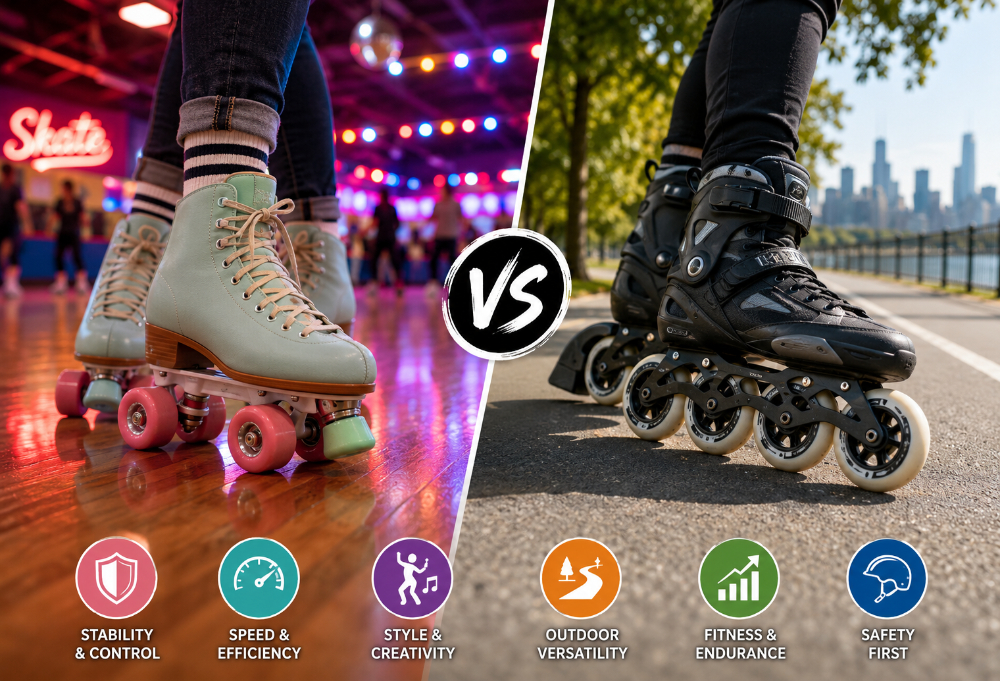
The core of the “harder” debate lies in the fundamental design of inline skates and quad skates. Their wheel configurations dictate how a skater interacts with the ground, influencing stability, balance, and movement.
Inline Skates: The Single-Line Design And Its Challenge
Inline skates feature wheels arranged in a single line from front to back. This design supports efficient forward motion and longer glides, but it also creates a narrower base of support than quads.
Maintaining balance requires more precise control over the body’s center of gravity, since the wheels offer less lateral stability than quad skates. Many inline models use three to five wheels, and some performance skates use a slight rocker setup to improve turning and agility. This design is optimized for cruising, fitness skating, speed, and covering distance.
The boots are often more supportive, with many fitness and aggressive models using higher-cut shells or stiff cuffs to improve ankle control during acceleration, turns, and landings.
Quad Skates: The Stable Foundation
Quad skates, the classic roller skates, have a distinct four-wheel setup: two wheels in the front and two in the back, forming a rectangular base. This wider stance provides a larger contact area with the ground, offering a more stable platform. That added stability is a major reason many beginners find quads easier to start on.
The two-by-two wheel arrangement helps with balance, especially when stationary or moving slowly. Quads are also known for their strong pivoting and turning ability, thanks to the truck system that allows the plate and wheels to tilt and steer. The boots can range from low-cut artistic styles to high-top derby skates, with each design offering different levels of ankle support and flexibility.

Credit: www.youtube.com
The Learning Curve: Where Does The Difficulty Lie?
When asking if inline skates are harder than quads, the most common interpretation relates to the initial learning curve and the ease with which a new skater can achieve basic proficiency.
Mastering Balance: Inline Skates’ Initial Hurdle
For most people with no prior skating experience, inline skates present a more difficult initial balance challenge. The narrow wheelbase means the skater’s weight must stay centered over the wheels. A slight shift can cause instability, especially for beginners who have not yet developed skating posture and edge control.
This requires subtle posture adjustments and core engagement. Beginners often wobble more and struggle to stand still or take their first few strides. The learning process can feel frustrating at first, especially before muscle memory and balance skills develop.
Stopping can also be a major hurdle on inlines. Many recreational models use a heel brake, and learning to use it correctly takes practice. Other common stopping methods include the T-stop and plow stop, which are useful but also require coordination and speed control.
Quad Skates: A More Forgiving First Experience
Quad skates, with their wider stance, generally offer a more forgiving learning experience. The broader base of support makes it easier for beginners to feel stable and confident. Standing still is usually less precarious, and taking initial strides often feels more natural.
The ability to lean slightly without immediately losing balance is a major advantage for new skaters.
Braking on quads is often perceived as more intuitive. Many quad skates come equipped with a toe stop, which allows skaters to brake by shifting weight forward and using the stop on the ground. That said, the toe stop is not an automatic skill; new skaters still need to learn how to use it safely and avoid leaning too far forward.
This increased initial stability and simpler-feeling braking often translate to a faster sense of progress for beginners on quads.

Credit: rollbackworld.com
Maneuverability And Agility: Different Tools For Different Moves
Beyond initial learning, the inherent design of each skate type shapes movement, turning, and agility. This is where the perception of “hardness” can shift, depending on the skater’s intended use.
Inline Skates: Speed And Straight-Line Efficiency
Inline skates are built for efficient forward motion. The single line of wheels helps reduce rolling resistance and supports smooth gliding, making them a strong choice for fitness skating, distance skating, and speed-oriented use.
Turning sharply on inline skates usually requires leaning into the turn and using controlled edging, similar to carving on skis or a snowboard. Advanced skaters can perform spins and fast directional changes, but that level of control takes more practice than it does on quads.
At higher speeds, sudden stops and tight maneuvers demand solid technique, good gear fit, and confidence on the wheels.
Quad Skates: Pivots, Spins, And Freestyle Fun
Quad skates excel in situations requiring quick pivots, spins, and intricate footwork. The truck system allows greater side-to-side freedom, making quads a popular choice for figure skating, roller derby, and dance skating. The ability to shift weight and tilt the skates supports dynamic changes in direction.
While quads can build speed, they usually feel less efficient for long-distance cruising than inlines. Their strengths are tighter turns, responsive footwork, and styles that rely on quick changes in body position.
The wheel placement also supports movements like spins and dance steps that are generally more difficult to execute with the same ease on inline skates.
Credit: skateliberty.net
Factors Influencing Perceived Difficulty
The question of whether inline skates are harder than quads is not only about wheel configuration. Several other factors shape the experience and perceived difficulty.
Boot Design And Ankle Support
The type of boot plays a major role in comfort and control.
-
- Inline Skate Boots: Many inline skates, especially fitness and speed models, use supportive cuffs and stiffer boots to help with stability and power transfer. Some beginner models are softer, which can feel less secure. Aggressive inline skates use tough, impact-resistant shells designed for jumps, grinds, and hard landings.
- Quad Skate Boots: Quad skate boots vary widely. Artistic and dance skates often have softer, more flexible boots that allow more ankle movement, while roller derby and speed quads usually use more supportive boots for stability and performance.
Wheel Size, Hardness, And Surface Choice
Wheel choice has a major effect on how easy each skate feels to use. The best setup depends on where the skater plans to ride.
-
- Inline Skate Wheels: Recreational inline wheels are often smaller than speed wheels, and common sizes vary widely by model. Smaller wheels are usually easier for beginners to control, while larger wheels roll faster and handle rougher pavement more smoothly. Softer wheels tend to grip better, while harder wheels roll faster on smooth surfaces but can feel less forgiving.
- Quad Skate Wheels: Quad skate wheels are also available in many sizes and hardness levels. Softer wheels generally provide better grip and shock absorption outdoors, while harder wheels are better for smooth indoor floors. Smaller quad wheels tend to feel more agile, while larger quad wheels roll more smoothly over cracks and debris.
For beginners, a softer wheel with good grip is often easier to control outdoors, while a harder wheel can be better for clean indoor surfaces. Matching wheel choice to surface is one of the most overlooked parts of buying skates.
Intended Use And Skater Goals
Ultimately, the “hardness” is subjective and depends heavily on what the skater wants to achieve.
-
- Beginner Recreational Skating: For someone simply wanting to cruise around a park or boardwalk, quad skates may feel easier to start with due to their inherent stability.
- Speed and Fitness: If the goal is to achieve higher speeds and cover long distances efficiently, inline skates are usually the more suitable choice, though reaching that level takes dedicated practice.
- Tricks and Agility: For skaters interested in spins, pivots, and dance-like movements, quad skates offer a more direct pathway to those skills.
Comparing The Skating Experience: A Data-Driven Look
To better illustrate the differences, let’s consider a comparison focused on key aspects relevant to difficulty and performance.
Comparison Table: Inline Vs. Quad Skates
| Feature | Inline Skates | Quad Skates | Notes on Difficulty |
|---|---|---|---|
| Wheel Setup | Single line (front to back) | Two in front, two in back | Inline’s narrow base requires more precise balance; quads’ wider base offers more stability. |
| Initial Balance | More challenging; requires greater core control. | Easier; wider stance provides more stability. | Quads generally feel more stable for absolute beginners. |
| Forward Speed | High potential; efficient glide. | Moderate; can be achieved but usually with more effort. | Inlines are designed for speed and distance. |
| Maneuverability | Excellent for carving and forward turns. | Superior for quick pivots, spins, and lateral moves. | Quads excel at intricate footwork and tight turns; inlines are better for smooth, sweeping turns. |
| Braking | Usually heel brake, plus T-stop and plow stop. | Often toe stop, plus plow and transition stops. | Stopping skill is a major beginner hurdle on inlines, but quads still require practice. |
| Stability | Lower lateral stability. | Higher lateral and overall stability. | Quads feel more grounded and less prone to tipping sideways. |
| Learning Curve | Steeper initial curve, then higher speed potential. | Gentler initial curve, excels in specific styles. | The “hardness” depends on the goal: quads are easier to start; inlines are harder initially but rewarding for distance and speed. |
| Typical Use | Fitness, speed skating, hockey, aggressive skating. | Artistic skating, derby, dance, recreational skating. | The intended purpose shapes the ideal skate type and the associated challenges. |
Real-World Examples And Scenarios
To solidify the understanding of when one skate might be perceived as “harder” than the other, consider these scenarios:
Scenario 1: The Absolute Beginner At The Park
Imagine Sarah, who has never skated before, visiting a local park. She wants to casually roll around on paved paths.
-
- On Quad Skates: Sarah puts on her quad skates. The wide base immediately makes her feel more grounded. She can stand still with relative ease, and her first few steps feel wobbly but manageable. She finds the toe stop straightforward to use for slowing down. Within an hour, she’s tentatively cruising around and feeling a sense of accomplishment.
- On Inline Skates: Sarah tries inline skates. The narrower wheel setup feels less forgiving. Even standing still requires constant micro-adjustments. Her first few strides are a series of wobbles and near-falls. She struggles to find a comfortable stance and finds braking with the heel brake a significant challenge. It can take several sessions before she feels confident gliding more than a few feet without stopping.
In this scenario, quad skates are generally easier for Sarah to learn on.
Scenario 2: The Aspiring Speed Skater
Meet Alex, who wants to get into fitness skating and eventually join a recreational speed skating group. He needs to cover distances efficiently and build speed.
-
- On Quad Skates: Alex tries quad skates. While he can get them moving, the effort required to maintain a fast pace is usually higher than on inlines. The setup is not optimized for the long, gliding strides needed for speed.
- On Inline Skates: Alex puts on inline skates designed for fitness. The single line of wheels lets him glide more efficiently, and larger wheels can roll smoothly over small imperfections in the pavement. He still needs to practice stopping techniques, but the act of moving forward at speed feels natural and efficient once he has the basics down.
In this scenario, inline skates are the more effective tool for Alex’s goal.
Scenario 3: The Urban Explorer Wanting Agility
Consider Ben, who loves exploring city streets and wants to perform quick maneuvers and enjoy nimble movement.
-
- On Inline Skates: Ben finds that while his inline skates are great for cruising, making sharp turns or sudden directional changes can require more leaning and planning. Pivoting feels less immediate.
- On Quad Skates: Ben switches to quad skates. He immediately notices how easy it is to pivot and change direction. Weaving through obstacles feels more intuitive. The ability to shift weight laterally allows for quick adjustments. While he may not reach the same top speed as on inlines, the agility and responsiveness make his skating feel more dynamic.
In this scenario, quad skates offer greater agility for Ben’s specific goal.
Skill Development And Progression: What Comes Next?
The initial difficulty is just one part of the story. As skaters progress, the challenges and rewards evolve.
Advancing On Inline Skates
Once a skater overcomes the initial balance hurdles on inline skates, a world of speed and efficiency opens up. The focus shifts to refining techniques for:
-
- Advanced Braking: Mastering the T-stop, heel brake variations, plow stops, and controlled slides for safer stopping at different speeds.
- Carving and Edge Control: Developing precise control over turns and leaning into them for smooth, efficient arcs.
- Agility and Jumps (Aggressive Inlines): For aggressive inline skaters, the focus is on mastering grinds, aerial maneuvers, and landings, which requires significant strength, balance, and courage.
- Endurance Skating: Building stamina for long-distance skating and optimizing stride and posture for efficiency.
The “hardness” here becomes about refining technique and pushing performance limits.
Advancing On Quad Skates
Progression on quad skates often involves developing a deeper understanding of body mechanics and balance for more complex movements:
-
- Artistic and Dance Skating: Mastering spins, jumps, footwork sequences, and transitions that require exceptional balance, flexibility, and precision.
- Roller Derby: Developing agility for quick evasive maneuvers, power skating for speed, and the ability to absorb and deliver controlled impacts.
- Freestyle and Park Skating: Performing tricks like manuals, pivots, and spins in skate parks, often involving jumps and grinds.
The “hardness” on quads lies in mastering the intricate control and artistry that their design facilitates.
Frequently Asked Questions
What’s The Easiest Type Of Skate To Learn On?
Generally, quad skates are considered easier for absolute beginners to learn on due to their wider base of support, which provides greater inherent stability. This makes it easier to balance and get moving without feeling as precarious as on inline skates.
Can I Learn To Skate As An Adult?
Absolutely! Learning to skate as an adult is very achievable. Many adults take up skating for fitness, recreation, or as a new hobby. While adults might initially feel less coordinated than children, their developed sense of balance and understanding of movement can be advantageous. Resources like how to learn skateboarding as an adult can offer valuable insights applicable to roller sports.
Are Inline Skates Bad For Your Knees?
Inline skates are not inherently bad for your knees. Like any physical activity, improper technique, falls, or overexertion can lead to injury. However, skating is generally lower impact than running, and proper form, appropriate safety gear, and gradual progression help reduce risk.
How Long Does It Take To Learn To Skate On Inlines Vs. Quads?
The time it takes to learn varies greatly depending on the individual, their prior experience with similar activities, and the amount of practice. However, beginners can usually achieve basic proficiency, such as standing, gliding short distances, and stopping, more quickly on quad skates than on inline skates. Mastering advanced skills on either type of skate requires consistent practice over weeks and months.
Can I Do Tricks On Both Inline And Quad Skates?
Yes, you can do tricks on both types of skates, but the types of tricks and the skill set required differ significantly. Quad skates are ideal for spins, pivots, dance-like footwork, and many artistic moves. Inline skates, particularly aggressive inline skates, are designed for grinds, aerial maneuvers, and park tricks. Fitness or speed inline skates are not typically used for tricks.
In summary, the question of whether inline skates are harder than quads doesn’t have a simple yes or no answer. It depends on your starting point, your goals, and what aspect of skating you prioritize. Quad skates offer a more stable and forgiving introduction for many, making them easier to get started with.
Inline skates, while presenting a steeper initial learning curve, unlock greater speed and efficiency for forward motion once mastered. Both offer unique pathways to enjoyment, fitness, and skill development within the diverse world of skating. The best way to find out which feels “harder” or “easier” for you is to try both and see which matches your goals and comfort level.