
The world of skateboarding is built on the foundation of the deck, the plank you stand on. While most skateboarders are familiar with the standard maple construction, a rising contender has been making waves: bamboo. This natural, sustainable material offers a unique set of properties that appeal to a growing segment of the skateboarding community. But when it comes to performance, durability, and feel, how does bamboo stack up against the tried-and-true maple?
Choosing the right deck material can significantly impact your skateboarding experience, affecting everything from how the board flexes and pops to its weight and environmental footprint. For seasoned riders and beginners alike, understanding the nuances between bamboo and maple is key to making an informed decision that aligns with their riding style and values.
This comprehensive guide will break down the core differences, advantages, and disadvantages of bamboo versus maple skateboard decks, helping you determine which material is the best fit for your next ride.
Key Takeaways
- Maple is the traditional and most common skateboard deck material, known for its stiffness, pop, and durability, making it ideal for street and park skating.
- Bamboo offers a more flexible, lighter, and sustainable alternative, often favored for cruising, longboarding, and riders seeking a unique flex and rebound.
- Durability is a trade-off: Maple generally withstands impacts and abrasion better, while bamboo’s flex can sometimes lead to delamination or snapping under extreme stress if not constructed properly.
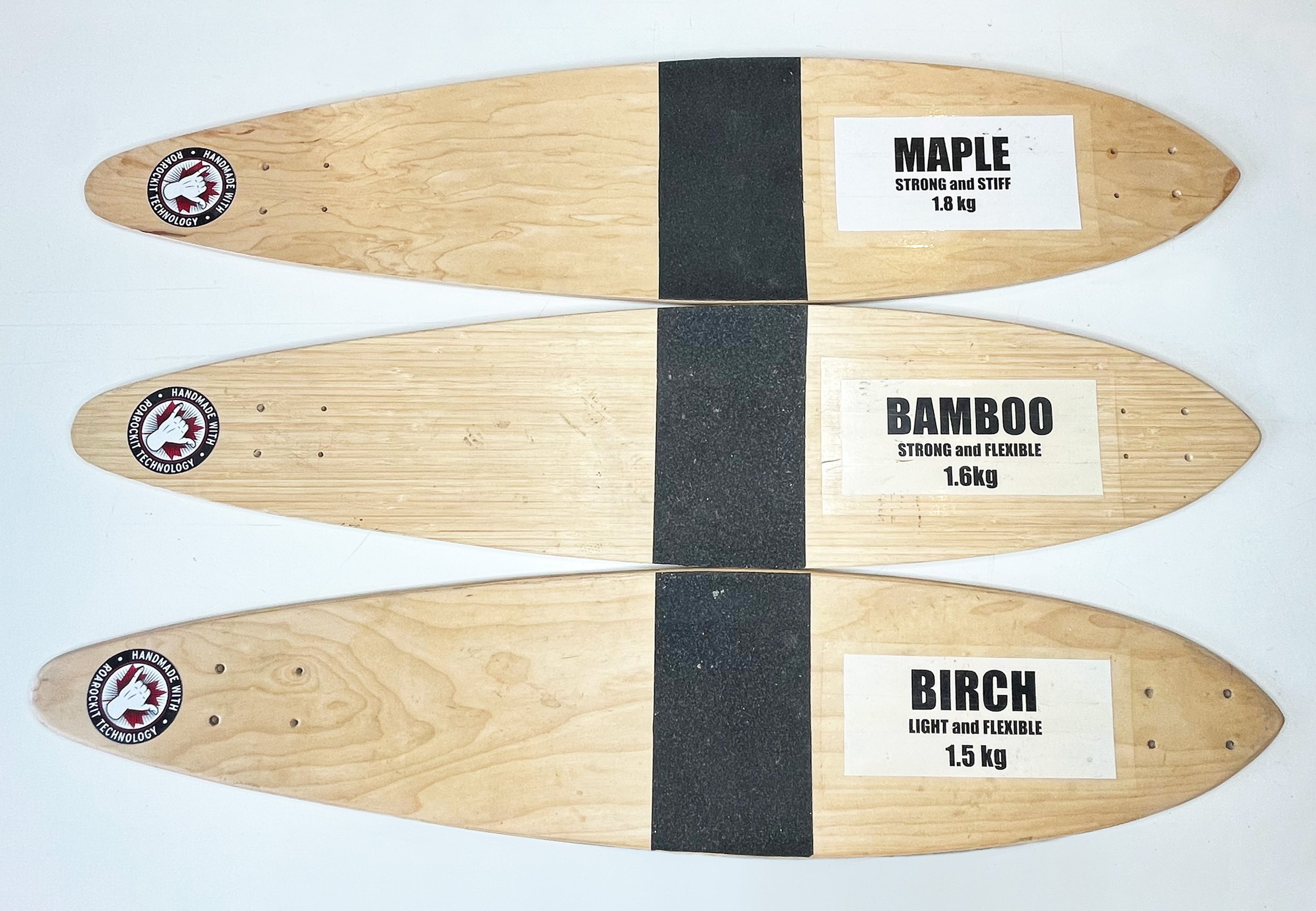
- Weight is a notable difference: Bamboo decks are typically lighter than maple decks of comparable size.
- Flex and Pop are distinct: Maple provides a stiff, responsive “pop” for tricks, whereas bamboo offers a springier flex that absorbs shock and provides a smoother ride.
- Environmental Impact favors bamboo due to its rapid growth and renewability, though manufacturing processes for both materials have their own footprints.
- Cost can vary, with bamboo decks sometimes being more expensive due to specialized manufacturing processes, but this is not always the case.

Credit: htrbamboo.com
The Reign Of Maple: A Skateboard Staple
For decades, Canadian maple has been the undisputed champion in skateboard deck construction. Its widespread adoption is not accidental; it’s rooted in a combination of excellent performance characteristics that cater to the demands of skateboarding. Typically, decks are made from 7-ply maple veneers pressed together with strong adhesive. This layered construction is what gives maple its signature stiffness and responsiveness.
Properties Of Maple Decks
Maple wood is renowned for its high density and stiffness. This means that when you stomp on a maple deck, it doesn’t flex excessively. This rigidity is crucial for performing tricks that require a sharp “pop” off the ground, such as an ollie or kickflip. The board needs to transfer the energy from your legs directly into the tail or nose to get airborne. Maple excels at this, providing a consistent and reliable platform for technical maneuvers.
Furthermore, maple is relatively durable and abrasion-resistant. While skateboards are inherently prone to wear and tear, especially when used for street skating involving grinds and slides, maple holds up reasonably well. The strength of the wood, combined with the robust glue used in the pressing process, allows it to withstand the impacts and stresses of regular skateboarding. This makes maple decks a cost-effective choice in the long run, as they tend to last a good amount of time before needing replacement, assuming they aren’t broken by a catastrophic impact.
Why Maple Dominates
The prevalence of maple in the skateboarding industry is also due to its availability and cost-effectiveness. Canadian maple forests are a sustainable resource, and the manufacturing process for maple decks is well-established and efficient. This means that maple decks are readily available from a vast array of manufacturers, from budget-friendly options to high-end pro models. For instance, brands like Element Skateboards and Santa Cruz Skateboards have built their reputations on using high-quality maple for their decks, offering a consistent product that skaters trust. Understanding the nuances of deck construction, regardless of material, is vital, as detailed in guides like the How to Choose a Skateboard Deck: Expert Tips for Perfect Fit.
The “pop” that maple decks provide is a defining characteristic. This refers to the responsiveness and snap of the tail or nose when flicked against the ground. A good pop allows skaters to easily get the board into the air for tricks. Maple’s stiffness is the primary contributor to this desirable trait, making it the go-to material for street skaters, park riders, and vert skaters who rely on explosive ollies and flip tricks.

Credit: www.fysboard.com
Bamboo: The Eco-conscious And Flexible Alternative
Bamboo, a type of grass, has emerged as a compelling alternative to maple in skateboard deck manufacturing. Its unique properties offer a different feel and performance profile, attracting riders who prioritize sustainability, a lighter ride, or a more forgiving flex.
The way bamboo is processed and incorporated into decks can vary, but often it involves laminating bamboo veneers, sometimes in combination with maple or fiberglass, to create a strong yet flexible structure.
The Advantages Of Bamboo
One of the most significant advantages of bamboo is its sustainability. Bamboo is one of the fastest-growing plants on Earth, capable of growing several feet in a single day. It requires minimal water and no pesticides, making it an environmentally friendly material. This rapid growth cycle means that bamboo can be harvested sustainably without depleting resources, a stark contrast to traditional hardwood forests. This appeals to skaters who are increasingly conscious of their environmental impact, aligning with a broader movement towards sustainable practices in sports and lifestyle products.
Beyond its eco-credentials, bamboo offers a distinct flex and rebound. Unlike the stiff nature of maple, bamboo decks tend to have a lively, springy feel. This flex can absorb vibrations from rough surfaces, leading to a smoother and more comfortable ride, especially for cruising or longboarding. This characteristic also means that bamboo decks can feel more forgiving underfoot, providing a slightly more cushioned landing for jumps. This springiness can also translate to a unique kind of “pop,” though it’s often described as more of a rebound than a sharp snap.
Weight is another area where bamboo shines. Bamboo is naturally lighter than maple. When used in skateboard decks, this results in a lighter overall board. A lighter board can be easier to maneuver, flip, and carry, which can be beneficial for skaters of all levels, especially those learning new tricks or commuting.
Considerations For Bamboo Decks
While bamboo offers many benefits, it’s important to understand its limitations. The inherent flexibility that makes bamboo comfortable can also be a double-edged sword. In some cases, particularly with less robust construction methods or for riders who put extreme stress on their decks, bamboo can be more prone to delamination (layers separating) or snapping under severe impact compared to a stiff maple deck. However, advancements in manufacturing and the use of composite materials alongside bamboo have significantly improved their durability.
The feel of a bamboo deck is also different. Some skaters accustomed to the direct, stiff feedback of maple might find the flex of bamboo less responsive for very technical street skating. While it offers a unique “carvy” feel, the precise control needed for intricate flip tricks might be slightly compromised for some riders. This makes bamboo a better fit for certain riding styles, like cruising, carving, or freeride longboarding, although high-performance bamboo decks are certainly available for more aggressive styles.
Bamboo Vs. Maple: A Direct Comparison
To better understand the differences, let’s break down the key characteristics of bamboo and maple skateboard decks side-by-side. This comparison highlights where each material excels and where it might fall short depending on your priorities as a skater.
Performance Characteristics
| Feature | Maple Skateboard Deck | Bamboo Skateboard Deck |
|---|---|---|
| Stiffness | High; provides a rigid platform. | Moderate to High; offers more flex. |
| Pop | Excellent, crisp “snap” for tricks. | Good, lively rebound; can feel less sharp than maple. |
| Flex | Minimal; designed for responsiveness. | Significant; absorbs shock and provides a smooth ride. |
| Weight | Standard; considered the baseline. | Lighter; easier to handle and maneuver. |
| Durability | High resistance to impact and abrasion. | Good, but can be more susceptible to delamination or snaps. |
| Feel | Direct, responsive, stiff. | Springy, smooth, forgiving. |
| Ride Comfort | Can be rougher on uneven surfaces. | Smoother due to shock absorption. |
Sustainability And Environmental Impact
Maple: While maple is a renewable resource, the harvesting and processing of hardwood can have a more significant environmental impact compared to bamboo. Deforestation concerns, transportation emissions, and energy used in manufacturing contribute to its footprint. However, many skateboard manufacturers guide prioritize sustainable forestry practices.
Bamboo: Bamboo is a highly sustainable resource due to its rapid growth rate and minimal need for cultivation inputs. Its cultivation can even help prevent soil erosion. The primary environmental considerations for bamboo decks lie in the adhesives and manufacturing processes used, which can be energy-intensive. Nevertheless, the raw material itself offers a greener alternative.
Cost And Availability
Maple: Maple decks are widely available and come in a broad price range, from very affordable beginner decks to premium pro models. Their ubiquity makes them easy to find from almost any skate shop or online retailer.
Bamboo: Bamboo decks can sometimes be more expensive than comparable maple decks. This is often due to the specialized manufacturing techniques required to work with bamboo and its composite nature. However, as bamboo gains popularity and production scales up, the price difference is becoming less pronounced, and some bamboo decks are competitively priced.
Credit: www.thinairpress.com
Understanding Deck Construction: Beyond The Material
The material is only one piece of the puzzle when it comes to skateboard deck performance. Construction methods play a crucial role in how both maple and bamboo decks behave. The type of glue used, the number of plies, the pressing technique, and whether other materials like fiberglass or carbon fiber are incorporated can all significantly alter the final product.
Maple Construction Nuances
Standard maple decks are typically constructed from 7-ply Canadian maple. The “ply” refers to a single thin sheet of wood veneer. These veneers are cross-grained and laminated together under high pressure with strong, waterproof glues. The orientation of the grain in each ply is alternated to maximize strength and prevent warping. Some high-end maple decks might incorporate additional materials, such as a carbon fiber sheet in the middle ply, to enhance stiffness, strength, and pop while keeping the weight down. This is a common practice for professional-grade decks designed for demanding use.
Bamboo Construction Variations
Bamboo decks can be built in several ways. Some are made entirely from bamboo veneers, pressed and shaped. Others use a hybrid construction, where bamboo veneers are laminated with maple veneers or other materials like fiberglass. This approach aims to leverage the benefits of both materials, the flexibility and sustainability of bamboo, combined with the stiffness and proven durability of maple or the strength of fiberglass. For example, a deck might have a bamboo core sandwiched between maple layers, or a bamboo top and bottom ply with a maple core.
The concave of the deck, the curvature across its width, also impacts how the material performs. A deeper concave generally increases stiffness and provides more foot lock-in for turns and slides, while a mellower concave can offer a more natural feel. The shape and depth of the concave, combined with the material properties, dictate the overall riding experience. For a deeper dive into choosing the right deck shape and size, explore resources on how to choose a skateboard deck.
Riding Styles And Material Suitability
The choice between a bamboo and a maple skateboard deck often comes down to the intended riding style. While personal preference always plays a role, the inherent properties of each material make them better suited for certain types of skateboarding.
Street And Park Skating
For street skating and park skating, where aggressive tricks, ollies, flip tricks, grinds, and slides are common, maple is generally the preferred material. Its stiffness and sharp pop are essential for getting the board off the ground and executing technical maneuvers with precision. The durability of maple also helps it withstand the inevitable impacts and abrasion from street obstacles and skatepark features. While bamboo decks can be used, some riders find the slightly softer flex less ideal for the immediate, responsive feedback required for precise trick execution. However, some advanced bamboo constructions can hold their own.
Cruising, Commuting, And Longboarding
When it comes to cruising, commuting, or longboarding, bamboo often takes center stage. The flexibility and shock absorption of bamboo make for a significantly smoother and more comfortable ride, especially over rougher terrain. This forgiving nature reduces fatigue on longer rides and provides a more enjoyable experience for those who use their skateboard as a mode of transportation or for relaxed cruising. The lively rebound of bamboo can also add a fun, surfy feel to carving and turning. Many dedicated longboard manufacturers utilize bamboo extensively in their designs for these very reasons.
Transition And Vert Skating
For transition skating (like bowls and half-pipes) and vert skating, the choice can be more divided. Maple decks offer the stiffness and pop needed for launching off coping and performing aerial tricks. However, the smoothness and vibration-dampening qualities of bamboo can also be appealing in bowls, where the surface can be uneven and jarring. Lighter bamboo decks can also be easier to control in the air. Ultimately, for these disciplines, the rider’s personal preference for stiffness versus flex is the deciding factor.
Durability And Longevity: What To Expect
The durability of a skateboard deck is a critical factor for any rider, impacting how long their board will last and how often they’ll need to replace it. Both bamboo and maple decks have their strengths and weaknesses in this regard.
Maple Deck Longevity
Maple decks are known for their resilience to impact and abrasion. The dense wood and strong glue bond can withstand significant stress. However, maple decks have a finite lifespan, often referred to as “wearing out.” Over time, repeated impacts, especially to the tail and nose from ollies and landings, can cause the wood to become compressed and lose its pop. Pressure cracks can also develop, particularly around the truck mounting holes or where the deck experiences stress. While a maple deck can last for months or even years depending on usage, severe impacts can cause it to snap in half, rendering it useless.
Bamboo Deck Longevity
Bamboo decks offer a different kind of durability. Their flexibility can absorb impacts that might shatter a stiffer maple deck. This can make them more resistant to snapping from landing impacts. However, the flexibility can also lead to issues like delamination, where the layers of bamboo (or bamboo and other materials) begin to separate, especially if exposed to moisture or subjected to constant flexing without proper structural support. The edges of bamboo decks can also be more prone to chipping or fraying if they are not properly sealed or reinforced. For riders who are very hard on their gear, understanding how to prevent common issues like pressure cracks on skateboard is important, regardless of material.
In my experience, the longevity of both types of decks is highly dependent on the quality of construction and the rider’s technique. A well-made bamboo deck from a reputable manufacturer can be just as durable, if not more so, than a poorly constructed maple deck, and vice versa. Riders who are careful with their landings and avoid grinding on rough surfaces will generally see their decks last longer.
Environmental Considerations And Sustainability
In an era of increasing environmental awareness, the sustainability of materials used in sporting goods is becoming a significant factor for consumers. Both bamboo and maple have their environmental profiles, but bamboo generally holds an advantage.
The Eco-profile Of Maple
Maple is a renewable resource, and responsible forestry practices ensure that harvested trees are replaced. However, the process of harvesting timber, transporting it, and manufacturing wood products can be energy-intensive and contribute to carbon emissions. The lifespan of a maple tree is much longer than the growth cycle of bamboo, meaning that replenishing harvested forests takes considerably more time.
The Green Credentials Of Bamboo
Bamboo is often hailed as one of the most sustainable materials available. It grows incredibly fast, reaching maturity in just 3-5 years, compared to decades for maple trees. It requires no replanting after harvest, as the root system continues to grow. Bamboo also absorbs significant amounts of carbon dioxide and releases more oxygen than many other plants, helping to combat climate change. Its cultivation also helps prevent soil erosion and requires minimal water and no chemical pesticides or fertilizers. This makes bamboo decks a compelling choice for environmentally conscious skaters.
Case Studies: Real-world Performance
To illustrate the practical differences, let’s look at how different skaters might experience bamboo and maple decks.
Example 1: The Street Shredder
- Rider: Alex, a 17-year-old who skates street and park daily, focusing on flip tricks and grinding ledges.
- Deck Choice: Traditionally uses 7-ply maple decks from brands like Baker or Powell-Peralta.
- Experience: Alex relies on the stiff, poppy feel of maple for consistent ollies and clean flip tricks. He finds that maple provides the direct feedback needed to control his board precisely during grinds and slides. While his maple decks eventually wear out and lose their pop, they generally withstand the abuse of street skating well until that point. He’s tried a bamboo deck once, finding it too flexible for his liking, making precise board control feel slightly mushy.
Example 2: The Commuter/Cruiser
- Rider: Sarah, a 25-year-old who uses her skateboard for commuting to work and casual cruising on weekends.
- Deck Choice: Recently switched to a bamboo longboard-style deck.
- Experience: Sarah was looking for a smoother, more comfortable ride than her old maple cruiser offered. The bamboo deck has significantly reduced the vibrations from rough pavement, making her commute much more pleasant. She enjoys the subtle flex and rebound, which gives her board a lively feel when carving through turns. The lighter weight also makes it easier to carry onto public transport. She doesn’t perform technical tricks, so the reduced “snap” compared to maple isn’t an issue.
Frequently Asked Questions
What Is The Primary Difference Between Bamboo And Maple Skateboard Decks?
The Primary Difference Lies In Their Material Properties: Maple Is Known For Its Stiffness, Pop, And Durability, Making It Ideal For Technical Tricks, While Bamboo Offers More Flex, Lightness, And Sustainability, Often Preferred For Cruising And Comfort.
Which Material Is Better For Beginners Learning Tricks?
For Beginners Focused On Learning Fundamental Tricks Like Ollies And Flip Tricks, A Maple Deck Is Generally Recommended. Its Stiffness And Responsive Pop Provide A More Predictable Platform For Practicing These Maneuvers. A Less Flexible Board Can Make It Easier To Get The Initial Pop Needed To Get Airborne. However, The Benefits Of Skateboarding Extend Beyond Trick Performance, Encompassing Physical And Mental Well-being, So Personal Comfort Is Also A Factor.
Are Bamboo Skateboard Decks More Expensive Than Maple Ones?
Typically, Yes, Bamboo Skateboard Decks Can Be More Expensive Than Comparable Maple Decks. This Is Often Due To The Specialized Manufacturing Processes, The Sourcing Of Bamboo, And Potentially Lower Production Volumes Compared To The Mass-produced Maple Market. However, Prices Vary Greatly By Brand And Construction, And Some Bamboo Decks Are Competitively Priced.
Which Material Is More Environmentally Friendly?
Bamboo Is Generally Considered More Environmentally Friendly. It’s A Rapidly Renewable Resource That Grows Quickly, Requires Minimal Cultivation, And Absorbs Significant Amounts Of Co2. Maple Is Also Renewable, But Its Growth Cycle Is Much Longer, And The Harvesting And Manufacturing Processes Can Have A Larger Environmental Footprint.
Can Bamboo Skateboard Decks Be Used For Street Skating And Tricks?
Yes, They Can, But With Some Considerations. While Bamboo Offers A Lively Flex That Some Riders Enjoy, It May Not Provide The Same Sharp, Crisp Pop That Many Street Skaters Prefer From Maple. Furthermore, While Bamboo Can Be Durable, Its Flexibility Might Make It More Susceptible To Certain Types Of Damage Like Delamination If Not Constructed With Robust Methods. High-performance Bamboo Decks With Composite Reinforcements Are Increasingly Capable Of Handling Street Skating Demands. For Those Interested In Protective Gear, Exploring skateboard Deck Rails Can Also Extend The Life Of A Deck.
The choice between a bamboo and a maple skateboard deck ultimately hinges on your individual priorities as a rider. If you’re a street skater or park rider who demands maximum pop, responsiveness, and a stiff platform for technical tricks, the time-tested performance of maple remains the industry standard for good reason. Its durability and predictable feel make it a reliable workhorse for aggressive skating.
Conversely, if you value a smoother ride, lighter weight, and a more environmentally conscious choice, bamboo presents an excellent alternative. Its natural flex and shock absorption are ideal for cruising, commuting, and longboarding, offering a comfortable and engaging experience. As manufacturing techniques continue to evolve, the lines between these materials may blur further, with innovative constructions offering the best of both worlds. Whether you’re learning your first ollie, as detailed in Categories Comparison