
Skateboarding and running are two vastly different yet equally popular forms of physical activity, each offering a unique set of benefits for the body and mind. While both can contribute to a healthier lifestyle, the question of which is “better” is subjective and depends entirely on individual goals, preferences, and physical capabilities.
Running is often lauded for its simplicity and accessibility, requiring little more than a pair of shoes and open space. Skateboarding, on the other hand, involves a steeper learning curve and a specific piece of equipment, but it opens up a world of creativity, skill-building, and a distinct subculture. Understanding the distinct advantages and disadvantages of each activity is crucial for making an informed choice. This exploration will break down the physical, mental, and social aspects of both skateboarding and running, providing a comprehensive comparison to help you decide which might be the better fit for your personal fitness journey. We’ll examine everything from calorie burn and muscle engagement to mental health benefits and the sheer joy factor, ensuring you have all the information needed to make a decision that aligns with your lifestyle and aspirations.
Key Takeaways
-
- Cardiovascular Health: Both running and skateboarding significantly improve cardiovascular health, but running generally offers a more consistent and higher-intensity aerobic stimulus, while skateboarding tends to function more like interval cardio with variable effort bursts and recovery phases.
- Calorie Burn: Running typically burns more calories per hour than skateboarding, especially at moderate to high intensities. However, vigorous skateboarding sessions can still produce substantial energy expenditure, and long sessions may narrow the gap.
- Muscle Engagement: Running primarily targets lower-body muscles (quadriceps, hamstrings, calves, glutes). Skateboarding also heavily involves the legs, but it adds more balance demand, core activation, and proprioceptive control.
- Impact and Injury Risk: Running is a high-impact activity that can be hard on joints and may contribute to overuse injuries. Skateboarding often places less repetitive load on the joints during cruising, but it carries a meaningful fall risk, with wrist, ankle, and head injuries being major concerns.
- Skill Development and Creativity: Skateboarding excels in fostering creativity, balance, coordination, and problem-solving skills through learning tricks and navigating terrain. Running requires less technical skill but develops endurance, pacing, and efficiency.
- Mental Health Benefits: Both activities can reduce stress and improve mood. Skateboarding adds confidence-building, resilience, and community connection, while running is often valued for its rhythmic, meditative effect.
- Accessibility and Cost: Running is highly accessible with minimal equipment costs. Skateboarding requires a board and protective gear, and suitable terrain matters more for safety and enjoyment.
- Social Aspect: Running can be solitary or social. Skateboarding often thrives in skate parks and street spots, fostering a strong sense of community and shared progression.
- Practical Reality: The best choice is often the one you’ll do consistently. Adherence matters as much as raw exercise intensity.
Credit: www.airkayaks.com
Cardiovascular And Calorie Burn Comparison
When considering the physical benefits of any exercise, cardiovascular health and calorie expenditure are often at the forefront. Both running and skateboarding can contribute positively to these areas, but they do so in different ways and to varying degrees. Understanding these nuances can help individuals choose an activity that best aligns with their fitness objectives.
Cardiovascular Endurance
Running is a classic aerobic exercise, renowned for its ability to strengthen the heart and lungs. The rhythmic, repetitive motion of running elevates your heart rate consistently, improving your body’s ability to transport oxygen to your muscles. A steady-state run, or interval training, can significantly enhance your VO2 max, which is a measure of the maximum amount of oxygen your body can use during intense exercise. This makes running a highly effective tool for building cardiovascular endurance, which translates to better stamina in everyday activities and improved athletic performance across various sports.
Skateboarding, while often perceived as more of a recreational activity, also provides a robust cardiovascular workout, especially during longer sessions or when incorporating more dynamic movements like cruising, pumping, or attempting tricks. The act of pushing off the ground with your foot, maintaining balance, and maneuvering the board engages your heart and lungs. Skateboarding is not steady-state cardio in the same way running is; instead, it tends to work more like interval training, with short bursts of effort followed by brief recovery while rolling or resetting. That pattern can still be highly effective for conditioning, especially during park sessions, downhill riding, or long cruising sessions. However, the intensity can be more variable. A casual cruise might offer a moderate cardiovascular benefit, whereas sessions focused on aggressive skating, downhill skateboarding, or continuous ollie practice can push your heart rate into higher zones, rivaling some forms of running. The varied intensity means that while skateboarding can be great for cardio, it might not provide the same consistent, high-level aerobic stimulus as dedicated running training unless specifically approached that way.
Calorie Expenditure
The number of calories burned during exercise is a key metric for weight management and overall fitness. Generally, running burns more calories per hour than skateboarding, particularly at moderate to high intensities. For instance, a person weighing around 155 pounds might burn approximately 600-700 calories in an hour of running at a 10-minute mile pace. If the pace increases to 8 minutes per mile, that number can climb to over 800 calories per hour. Skateboarding calorie burn is more variable. A casual skateboarding session might burn around 300-400 calories per hour for the same 155-pound individual. However, more vigorous skateboarding, such as sustained cruising, park skating with frequent transitions, or downhill skateboarding, can increase this figure significantly, potentially reaching 400-600 calories per hour or even higher for very intense, trick-focused sessions. The constant need for balance, subtle muscle adjustments, and the physical exertion of pushing and turning contribute to this energy expenditure.
Example: Consider two individuals, both aiming to burn 500 calories.
-
- Runner: Might achieve this in approximately 45-60 minutes of moderate-paced running.
- Skateboarder: Might need 60-90 minutes of sustained, energetic skateboarding to reach the same 500-calorie burn.
Ultimately, for those whose primary goal is maximizing calorie burn in a set amount of time, running often holds the advantage. However, the enjoyment factor of skateboarding might lead individuals to spend longer durations engaged in the activity, thus increasing total calorie expenditure over time.
Muscle Engagement And Strength Building
Beyond cardio, the way an exercise engages different muscle groups contributes to overall physical fitness and functional strength. Both skateboarding and running offer distinct benefits in this regard, impacting different parts of the body.
Lower Body Focus In Running
Running is predominantly a lower-body workout. The primary muscles engaged include:
-
- Quadriceps: Responsible for extending the knee as your leg pushes off the ground.
- Hamstrings: Work to flex the knee and extend the hip.
- Calves (Gastrocnemius and Soleus): Crucial for pushing off the ground and stabilizing the ankle.
- Glutes (Gluteus Maximus, Medius, Minimus): Power hip extension and stabilize the pelvis.
- Tibialis Anterior: Lifts the foot during the swing phase of the gait cycle.
While running heavily emphasizes these muscles, it’s primarily for endurance rather than significant hypertrophy (muscle growth). Long-distance runners typically develop lean, strong muscles, but not the bulky mass seen in weightlifting. The repetitive, linear motion means that while muscles are strengthened, the range of motion and the variety of muscle firing patterns are somewhat limited compared to activities requiring more complex movements.
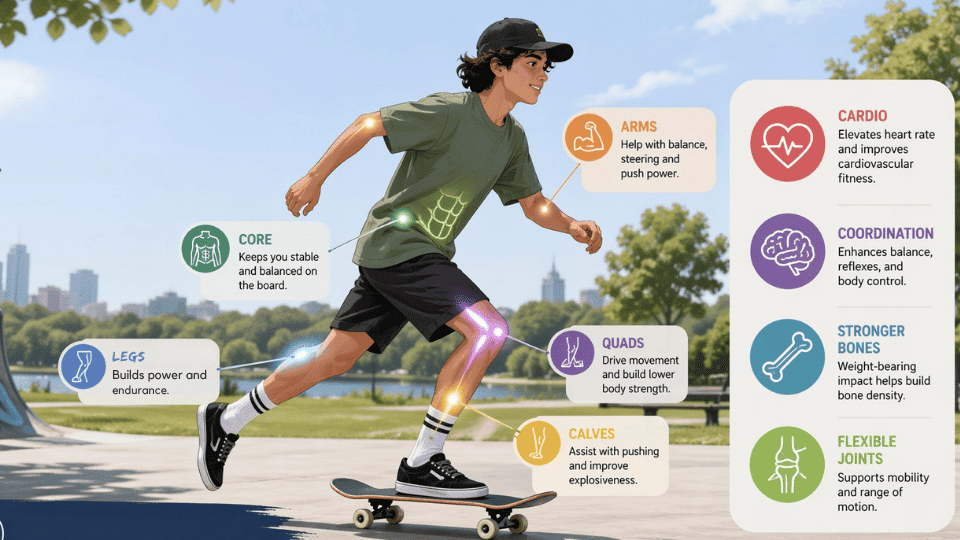
Full-body Workout In Skateboarding
Skateboarding offers a more comprehensive, full-body engagement. While the lower body is certainly active, it’s involved in a different way than in running.
-
- Legs: Used for pushing, balancing, absorbing impact, and performing tricks. Muscles like quadriceps, hamstrings, calves, and glutes are engaged, but often in more dynamic and stabilizing roles. For example, bending your knees to absorb an impact from landing a trick works the quads and glutes isometrically and dynamically.
- Core (Abdominals, Obliques, Lower Back): This is where skateboarding truly shines. Maintaining balance on a moving board requires constant engagement of the core muscles. Every subtle shift in weight, every adjustment to stay upright, and every twist to turn or land a trick relies heavily on a strong and responsive core. This leads to improved stability, posture, and reduced risk of back pain.
- Upper Body: While not the primary focus, the upper body plays a vital role in skateboarding. Arms are used for balance, and the shoulders and chest muscles can be engaged when pushing off or performing certain tricks. The forearms and hands are also used for support during falls or when getting up.
Comparison of Muscle Engagement:
| Muscle Group | Running | Skateboarding |
|---|---|---|
| Lower Body | High engagement (quads, hamstrings, calves) | Moderate to high engagement (legs, glutes, ankles) |
| Core | Moderate engagement (stabilization) | High engagement (balance, stability, power transfer) |
| Upper Body | Low engagement (minimal stabilization) | Moderate engagement (balance, arms, shoulders) |
| Type of Strength | Primarily endurance-focused | Mix of endurance, stability, and explosive power |
The varied and often asymmetrical movements in skateboarding contribute to developing proprioception (your body’s awareness of its position in space) and functional strength that translates well to other athletic activities and daily life.
Impact On Joints And Injury Risk
One of the most significant differences between running and skateboarding lies in their impact on the body’s joints and the types of injuries they commonly present. Both activities carry risks, but the nature of these risks differs considerably.
The High-impact Nature Of Running
Running is inherently a high-impact activity. With each stride, your body absorbs a force equivalent to two to three times your body weight. This repetitive stress, while strengthening bones over time, can also lead to overuse injuries, particularly in the lower extremities. Common running injuries include:
-
- Shin Splints: Pain along the shinbone, often caused by overuse or improper footwear.
- Runner’s Knee (Patellofemoral Pain Syndrome): Pain around or behind the kneecap, often related to muscle imbalances or overuse.
- Stress Fractures: Tiny cracks in bones, usually in the feet or lower legs, caused by repetitive force.
- Plantar Fasciitis: Inflammation of the band of tissue running across the bottom of your foot.
- Achilles Tendinitis: Inflammation of the Achilles tendon, connecting the calf muscle to the heel bone.
While running strengthens the bones and muscles, the cumulative impact can be detrimental for individuals with pre-existing joint issues or those who don’t manage their training load effectively. Proper form, appropriate footwear, and adequate rest are crucial for mitigating these risks.
Skateboarding: Falls And Joint Stress
Skateboarding presents a different spectrum of injury risks. While the repetitive impact on joints like the knees and ankles can be less consistent than in running, the primary risk comes from falls. Falls can lead to:
-
- Sprains and Fractures: Ankle sprains are very common, as are fractures of the wrist, arm, and collarbone when trying to break a fall.
- Head Injuries: Concussions and more severe traumatic brain injuries are a significant concern, underscoring the importance of wearing a helmet.
- Bruises and Abrasions: Common from sliding or falling on rough surfaces.
However, skateboarding can also be less jarring on the knees and hips than running, especially when cruising or performing smooth transitions. The ability to bend your knees and absorb impact through your legs can dissipate force more effectively than the percussive impact of each running stride. The development of balance and core strength can also lead to fewer falls over time.
Injury Risk Comparison:
| Risk Factor | Running | Skateboarding |
|---|---|---|
| Primary Risk | Overuse injuries, joint stress | Falls, acute injuries (sprains, fractures) |
| Common Injuries | Shin splints, runner’s knee, stress fractures | Ankle sprains, wrist fractures, head injuries |
| Joint Impact | High, repetitive | Variable, can be lower during cruising |
| Protective Gear | Primarily shoes | Helmet, pads, and wrist guards are strongly recommended |
| Learning Curve | Low for basic movement, high for efficiency | Moderate to high for basic competence |
Pro Tip: For both activities, proper warm-up and cool-down routines are essential. For skateboarding, wearing protective gear, including a helmet, knee pads, elbow pads, and wrist guards, significantly reduces the risk and severity of injuries. For running, investing in well-fitting shoes and considering gait analysis can help prevent overuse injuries. Skateboarding-specific safety also depends on the surface and environment: smooth pavement, skate parks, and designated skate spots are far safer than uneven sidewalks, wet ground, traffic-heavy roads, or crowded public spaces.

Credit: www.asics.com
Skill Development, Creativity, And Mental Benefits
The benefits of exercise extend far beyond the physical. Both running and skateboarding offer substantial advantages for mental well-being, skill development, and fostering a sense of accomplishment, albeit through different avenues.
The Mental Game Of Running
Running is often praised for its mental health benefits, commonly referred to as the “runner’s high.” This phenomenon is attributed to the release of endorphins, which act as natural mood boosters and pain relievers. Regular running can:
-
- Reduce Stress and Anxiety: The rhythmic nature of running can be meditative, helping to clear the mind and dissipate tension.
- Improve Mood: Endorphin release combats feelings of depression and enhances overall mood.
- Boost Self-Esteem: Achieving running goals, whether it’s completing a certain distance or improving speed, fosters a sense of accomplishment and self-efficacy.
- Enhance Cognitive Function: Studies suggest that aerobic exercise like running can improve memory, focus, and problem-solving skills.
While running requires strategy in pacing and endurance, the “skill” is primarily focused on mastering your own body’s capabilities and pushing your limits.
Skateboarding: Creativity, Resilience, And Community
Skateboarding offers a unique blend of physical challenge and creative expression. The learning process itself is a powerful mental exercise:
-
- Problem-Solving: Figuring out how to land a trick, navigate an obstacle, or maintain balance requires constant trial and error, fostering critical thinking and adaptability.
- Resilience and Grit: Skateboarding involves falling, getting back up, and trying again. This process builds incredible resilience, perseverance, and the ability to overcome fear and frustration.
- Creativity and Self-Expression: Skateboarding is often described as a physical art form. The way individuals choose to skate, the tricks they develop, and the spots they use are all forms of self-expression. There’s no single “right” way to skate.
- Confidence Building: Successfully landing a new trick after numerous attempts provides an immense boost in confidence and a tangible sense of achievement. This is particularly true for those learning skateboarding as adults, where overcoming perceived limitations can be profoundly empowering. How to Learn Skateboarding As an Adult: Essential Tips for Beginners.
- Mental Focus: The concentration required to execute a trick or navigate a challenging path sharpens mental focus and mindfulness.
Furthermore, skateboarding is deeply intertwined with culture and community. Skateboarding Culture Explained: Inside the World of Skate Life. Skate parks and street spots often become social hubs where skaters share tips, encourage each other, and build strong bonds. This sense of belonging and shared passion can significantly contribute to mental well-being, combating loneliness and providing a supportive network. The intrinsic motivation to progress and the social encouragement create a powerful loop for sustained engagement and mental health benefits.
Key Mental & Skill Differences:
| Aspect | Running | Skateboarding |
|---|---|---|
| Primary Mental Gain | Stress reduction, mood enhancement, endurance | Resilience, creativity, confidence, problem-solving |
| Skill Focus | Pacing, endurance, biomechanics | Balance, coordination, spatial awareness, trick execution |
| Creativity | Limited (route choice, pace variation) | High (style, trick combinations, terrain use) |
| Fear Factor | Moderate (injury, performance) | High (falls, impact), managed through practice |
| Social Aspect | Can be solitary or group | Often communal, driven by shared activity |
Accessibility, Cost, And Practical Considerations
When choosing a physical activity, practical factors like cost, accessibility, and the learning curve play a significant role in long-term adherence. Running and skateboarding present very different profiles in these areas.
Running: Low Barrier To Entry
Running is one of the most accessible forms of exercise available:
-
- Cost: The primary cost is a good pair of running shoes, which can range from $80 to $150. Beyond that, the activity itself is free. There are no membership fees or specialized locations required, although some may choose to join running clubs or pay for race entries.
- Accessibility: You can run almost anywhere, sidewalks, parks, trails, treadmills. This makes it incredibly convenient for people with busy schedules or those who travel frequently.
- Learning Curve: The basic mechanics of running are intuitive. While improving efficiency, speed, and preventing injury requires learning proper form and training principles, most people can start running immediately with minimal instruction.
Skateboarding: Investment And Learning Curve
Skateboarding requires a more significant initial investment and a more challenging learning process:
-
- Cost: A complete skateboard setup typically costs between $100 and $250, depending on the brand and quality. How to Choose a Skateboard Deck: Expert Tips for Perfect Fit. Essential safety gear, including a helmet, knee pads, elbow pads, and wrist guards, adds another $50-$100. While durable, skateboards and components do wear out and need replacement over time. Some popular brands include Element Skateboards (Are Element Skateboards Good? Honest Review and Buyer’s Guide) and Santa Cruz Skateboards (Are Santa Cruz Skateboards Good? Honest Review & Buyer’s Guide).
- Accessibility: While you can technically skateboard on any smooth, flat surface, ideal locations include skate parks, smooth paved areas, or designated skate spots. Finding safe and appropriate terrain can sometimes be a barrier, especially in areas without dedicated facilities. Skateboarding on public streets also carries risks due to traffic and uneven surfaces.
- Learning Curve: Skateboarding has a notoriously steep learning curve. Beginners often struggle with simply balancing, pushing, and turning. Learning basic tricks like the ollie can take weeks or months of consistent practice. This initial difficulty can be discouraging for some, but it’s also what makes the eventual progress so rewarding. For parents teaching children, patience is key. How to Teach a Kid to Skateboard: Easy Steps for Beginners.
Practical Considerations Table:
| Factor | Running | Skateboarding |
|---|---|---|
| Initial Cost | Low ($80-$150 for shoes) | Moderate ($150-$350 for board & gear) |
| Ongoing Cost | Low (shoe replacement every 300-500 miles) | Moderate (deck, wheels, bearings replacement) |
| Accessibility | High (anywhere with a flat surface) | Moderate (requires smooth, suitable terrain) |
| Learning Curve | Low (basic), High (advanced) | High (basic balance to advanced tricks) |
| Time Commitment | Flexible (short runs to long distances) | Requires dedicated practice sessions for progress |
| Equipment Need | Shoes (essential), comfortable clothing | Skateboard, helmet, pads (highly recommended) |
Which Is “better”? A Personalized Verdict
The question of whether skateboarding is “better” than running, or vice versa, is ultimately unanswerable without context. Both activities offer significant health benefits, but they cater to different needs, preferences, and goals. The “better” choice is the one that resonates most with you and that you are most likely to stick with consistently.
Choose Running if:
-
- Your primary goal is maximum cardiovascular conditioning and calorie burn in a limited time.
- You prefer a simple, low-cost entry into fitness.
- You value convenience and accessibility, needing minimal specialized locations or equipment.
- You enjoy the meditative, stress-reducing aspects of repetitive movement.
- You have joint issues that might be aggravated by the unpredictable nature of skateboarding falls, though the impact of running itself needs careful management.
Choose Skateboarding if:
-
- You are looking for a full-body workout that engages your core, balance, and coordination.
- You are drawn to creativity, self-expression, and the challenge of learning new skills.
- You thrive on overcoming challenges, building resilience, and developing grit.
- You enjoy social interaction and being part of a community with a shared passion.
- You are willing to invest time and resources into learning a new, dynamic skill. Skateboarding can be a fantastic way to boost confidence, especially for those looking to step outside their comfort zone. Benefits of Skateboarding: Boost Health, Confidence, and Fun.
Consider Both
Many individuals find value in incorporating both running and skateboarding into their fitness routines. Running can serve as excellent cross-training for skateboarding, building cardiovascular endurance and leg strength without the same impact risks. Skateboarding can offer a fun, creative outlet that complements the more structured nature of running. The key is to find a balance that keeps you active, engaged, and injury-free.
Frequently Asked Questions
What is the primary difference in the type of physical conditioning running and skateboarding provide?
Running primarily offers consistent, steady-state aerobic conditioning, focusing on cardiovascular endurance and lower body strength. Skateboarding, conversely, provides more of an interval-style workout with bursts of intense activity (pushing, tricks) interspersed with lower-intensity periods (cruising, balancing), leading to a more varied engagement of the core, balance, and coordination alongside leg strength.
How does the risk of injury differ between running and skateboarding?
Running carries a higher risk of overuse injuries like shin splints and stress fractures due to its repetitive, high-impact nature. Skateboarding’s primary injury risk stems from falls, leading to acute injuries such as sprains, fractures (especially wrists and ankles), and head trauma, necessitating protective gear.
Which activity is generally more effective for building core strength and balance?
Skateboarding is significantly more effective for building core strength and balance. The constant need to stabilize the body on a moving platform engages the core muscles continuously, developing functional strength and proprioception that is less emphasized in the linear motion of running.
What are the main mental health benefits associated with each activity?
Running is often associated with stress reduction and mood enhancement through endorphin release, offering a meditative quality. Skateboarding fosters resilience, grit, problem-solving skills, and confidence through the process of learning and overcoming challenges, alongside strong community-building aspects.
Considering accessibility and cost, which activity is easier for a beginner to start?
Running is far more accessible and less costly for beginners. It requires minimal equipment (just shoes) and can be done almost anywhere. Skateboarding demands an initial investment in a board and protective gear, and finding suitable, safe terrain can be a challenge, alongside a steeper learning curve for basic competence.