
The world of wheeled sports offers a thrilling escape, a chance to feel the wind, conquer gravity, and express oneself. At the heart of this culture lie two distinct, yet often conflated, forms of riding: skateboarding and longboarding. While both involve a deck, trucks, wheels, and bearings, their designs, purposes, and the experiences they offer are worlds apart. For newcomers and seasoned riders alike, understanding the fundamental differences between a skateboard and a longboard is crucial for choosing the right ride, mastering new skills, and fully appreciating the nuances of each discipline.
This comprehensive guide will break down the core distinctions, explore the unique riding styles associated with each, and help you determine which board best suits your aspirations. Whether you dream of carving down mountain roads, grinding rails at the skatepark, or simply cruising your neighborhood with effortless style, this exploration will equip you with the knowledge to make an informed decision.
Key Takeaways
-
- Purpose: Skateboards are built for tricks and street skating, emphasizing agility and maneuverability. Longboards are designed for speed, cruising, and downhill riding, prioritizing stability and smooth rides.
- Classification: A longboard is generally considered a type of skateboard, but one optimized for stability, comfort, and distance rather than technical tricks.
- Deck Shape & Size: Skateboards have shorter, symmetrical decks with kicktails for tricks. Longboards feature longer, often asymmetrical decks with various shapes (pintail, drop-through, etc.) optimized for stability and specific riding styles.
- Wheels: Skateboards use smaller, harder wheels for speed and trick performance. Longboards utilize larger, softer wheels for better grip, shock absorption, and maintaining momentum over rough surfaces.
- Trucks: Skateboard trucks are typically narrower and designed for quick turns and flip tricks. Longboard trucks are wider, often reverse-kingpin, for enhanced stability at higher speeds and deeper carves.
- Riding Style: Skateboarding involves ollies, flips, grinds, and park riding. Longboarding encompasses cruising, carving, downhill racing, freeride, and dancing.
- Learning Curve: Skateboarding generally has a steeper initial learning curve due to its focus on tricks and balance. Longboarding is often considered more accessible for beginners seeking a comfortable cruising experience.

Credit: www.ridingboards.com
The Fundamental Differences: Skateboard Vs. Longboard
At first glance, the two might seem interchangeable, but a closer inspection reveals significant design variations that cater to entirely different riding experiences. These differences stem from their intended purposes, influencing everything from deck dimensions to wheel characteristics.
Deck Design And Dimensions
The most apparent distinction lies in the deck. Skateboards are typically shorter, ranging from 28 to 33 inches in length and 6.5 to 8.5 inches in width. Their shape is often symmetrical or near-symmetrical, featuring a distinct nose and tail that curve upwards. These kicktails are essential for performing tricks like ollies, kickflips, and manuals, allowing the rider to pop the board off the ground or pivot.
Longboards, conversely, are considerably larger, generally measuring between 35 and 60 inches in length and 8 to 10 inches in width. Their shapes are far more diverse, designed for stability and specific riding styles. Common longboard shapes include:
-
- Pintail: Resembles a surfboard, with a wider nose and a tapered tail, ideal for cruising and carving due to its stability and comfortable foot placement.
- Drop-through: Trucks are mounted through cutouts in the deck, lowering the ride height and significantly increasing stability, perfect for downhill and freeride.
- Top-mount: Trucks are mounted underneath the deck, offering a higher center of gravity for more responsive carving and freeride.
- Cruiser: Smaller than other longboards but larger and more stable than skateboards, designed for commuting and relaxed riding.
- Dancing/Freestyle: Long, wide decks with ample space for footwork and intricate maneuvers, often with subtle kicktails for added versatility.
The concave (the side-to-side curvature of the deck) also differs. Skateboards often have a pronounced concave to help lock feet in place during tricks. Longboards may have a milder concave, or specialized concave shapes like W-concave or rocker (a slight upward curve) to enhance comfort and control for carving and downhill.
The wheelbase, or distance between the trucks, is another key practical detail. A shorter wheelbase usually feels more responsive and easier to turn, while a longer wheelbase adds stability at speed. That makes wheelbase one of the most important but overlooked factors when choosing a board.
Wheels: Size, Hardness, And Grip
The wheels are another critical differentiator. Skateboard wheels are typically smaller, ranging from 50mm to 60mm in diameter, and harder, with durometer ratings usually between 95a and 101a. This combination allows for faster acceleration, easier trick execution (less friction when sliding), and the ability to grind on ledges and rails. The smaller size also contributes to a lighter board, crucial for aerial maneuvers.
Longboard wheels are generally larger, from 65mm to 80mm or even larger in diameter, and softer, with durometer ratings typically between 75a and 85a. The larger diameter helps the board roll over cracks, pebbles, and rougher terrain with ease, maintaining momentum. The softer durometer provides superior grip on the pavement, absorbing vibrations and offering a smoother, more comfortable ride. This enhanced grip is vital for high-speed turns and controlled slides.
For commuting or rough pavement, larger and softer wheels are the most comfortable option; for park or street skating, smaller and harder wheels are usually preferred. Riders should also check wheel width and contact patch, since these affect grip, slide behavior, and speed more than diameter alone.
Trucks: Width And Geometry
Trucks connect the wheels to the deck and are responsible for turning. Skateboard trucks are usually narrower, matching the width of the deck, and feature a standard kingpin geometry. This setup is designed for quick, responsive turns and is integral to flip tricks and street skating.
Longboard trucks are typically wider, providing a larger wheelbase and greater stability. Many longboards use reverse kingpin trucks (RKP). In RKP trucks, the kingpin is reversed compared to standard skateboard trucks. This design offers a more stable ride at speed and allows for deeper, more fluid carves. The wider stance also contributes to overall stability, making them ideal for downhill racing and cruising.
Another practical difference is truck height. Lower setups improve stability and reduce push effort, while taller trucks can increase wheel clearance for larger wheels. For longboards, bushing durometer and pivot-cup condition also strongly affect turning feel, so setup matters almost as much as deck shape.
Bearings And Bushings
While both types of boards use bearings to allow the wheels to spin, the specific type and quality can influence performance. However, a more significant difference lies in the bushings within the trucks. Bushings are rubber or urethane rings that control how the truck turns.
Skateboard bushings are generally harder and designed for quick, sharp turns needed for tricks. Longboard bushings vary widely depending on the intended riding style. Softer bushings allow for easier, deeper carves and a more surf-like feel, while harder bushings offer more stability for downhill riding.
Riders often customize their bushing setups to fine-tune their board’s turning characteristics.
Riding Styles: What Can You Do With Each Board?
The distinct designs of skateboards and longboards naturally lend themselves to different riding disciplines and skill sets. Understanding these styles is key to choosing a board that aligns with your interests.
Skateboarding: The Art Of Tricks And Street Style
Skateboarding is synonymous with street skating, park skating, and vert skating. It’s about pushing the boundaries of balance, coordination, and creativity.
-
- Street Skating: This involves performing tricks on urban obstacles like stairs, handrails, ledges, and banks. Key tricks include ollies (jumping with the board), kickflips and heelflips (flipping the board 360 degrees), grinds (sliding along a ledge or rail on the trucks), and manuals (balancing on the back wheels). The symmetrical deck and kicktails are indispensable for these maneuvers. For beginners looking to get started with tricks, exploring easy skateboard tricks for beginners is a great starting point.
- Skatepark Skating: Skateparks are purpose-built environments featuring bowls, ramps, half-pipes, and various obstacles designed for skateboarding. Riders utilize the park’s features to perform aerial tricks, carves, and transitions. The agility of a skateboard is paramount here.
- Vert Skating: This discipline takes place on large, vertical ramps (half-pipes or vert ramps). Riders gain speed to launch into the air, performing complex aerial tricks and rotations. This style demands exceptional balance and board control.
- Freestyle Skateboarding: While less common today, traditional freestyle skateboarding involves intricate flat-ground tricks, often with a focus on manual variations and board spins.
Pro Tip: Mastering skateboarding requires dedication and practice. Patience is key, and celebrating small victories, like landing your first ollie, will keep you motivated.
Longboarding: Cruising, Carving, And Speed
Longboarding offers a broader spectrum of riding experiences, focusing more on flow, speed, and comfortable transportation.
-
- Cruising: This is the most accessible longboarding style. Riders use their boards for relaxed transportation, commuting, or simply enjoying a smooth ride. The stable, comfortable feel of a longboard makes it excellent for getting around town. Many people find longboarding a great way to get around their campus or city.
- Carving: Similar to surfing or snowboarding, carving involves making deep, flowing turns. The wider trucks and larger wheels of a longboard allow for smooth, fluid arcs across the pavement. Pintail and drop-through boards are particularly well-suited for this.
- Downhill: This high-speed discipline involves riding down steep hills. Riders focus on stability, aerodynamics, and control at speeds that can exceed 50 mph. Specialized downhill decks, wide RKP trucks, and grippy wheels are essential. Safety gear, including a full-face helmet, slide gloves, knee pads, elbow pads, and wrist protection, is non-negotiable.
- Freeride: Freeride combines elements of downhill and sliding. Riders perform controlled slides (like stand-up slides or powerslides) to manage speed and execute stylish maneuvers. Boards designed for freeride often have symmetrical shapes and specific concave features to aid in sliding and stability.
- Dancing/Freestyle Longboarding: This style emphasizes intricate footwork and maneuvers performed on the board while rolling, often on long, flat stretches or gentle slopes. It involves steps, pivots, and spins, requiring a long, wide deck with a flat profile.
Example: Professional longboarder Adam Colton is renowned for his downhill speed and technical freeride skills, showcasing the extreme capabilities of longboarding. His runs often involve precise line choices and controlled slides down challenging mountain roads.
Which Board Is Right For You? A Decision Guide
Choosing between a skateboard and a longboard hinges entirely on your personal goals and what you want to get out of riding. There’s no objectively “better” board; only the better board for you.
For The Aspiring Trickster And Street Shredder
If your vision involves ollieing over obstacles, grinding ledges, flipping your board, and mastering complex maneuvers in skateparks or on city streets, a skateboard is your clear choice.
-
- Consider a skateboard if:
- You’re interested in learning tricks like ollies, kickflips, and grinds.
- You plan to spend time in skateparks, bowls, or on street spots.
- You want a highly portable and agile board for quick maneuvers.
- You enjoy the challenge and progression of technical skateboarding.
If you’re new to skateboarding and aiming for tricks, starting with a reputable complete skateboard from brands like Element or Santa Cruz can be a good investment. Brands like Element Skateboards and Santa Cruz Skateboards have a long history of producing quality decks suitable for beginners and experienced riders. Learning to skateboard as an adult can be incredibly rewarding, and there are specific tips to help you learn skateboarding as an adult.
For The Commuter, Carver, And Speed Seeker
If your ideal ride involves smoothly cruising through your neighborhood, carving down hills with a surf-like feel, or seeking the thrill of high-speed downhill runs, a longboard is likely the better fit.
-
- Consider a longboard if:
- You want a stable, comfortable ride for commuting or transportation.
- You enjoy making smooth, flowing turns (carving).
- You’re interested in downhill riding or controlled sliding (freeride).
- You prefer a board that can handle rougher terrain with ease.
- You’re looking for a more relaxed introduction to board sports.
Longboards offer a gentler learning curve for basic riding and cruising. The history of longboarding is rich, evolving from early surfboard-inspired designs to the specialized boards we see today, as explored in the History of Longboarding. When choosing one, match the deck style to terrain: drop-through for lower speed and stability, top-mount for more aggressive carving, and pintails for relaxed cruising.
The Hybrid: Cruisers And Hybrid Boards
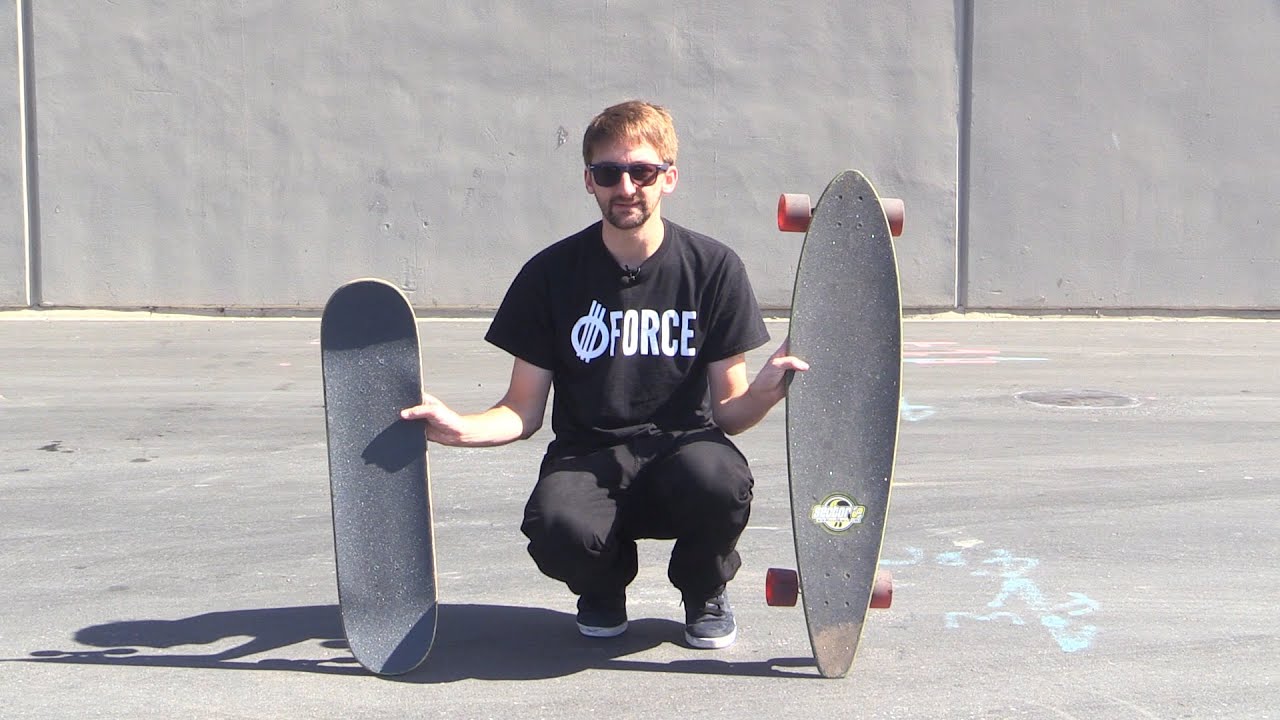
It’s worth noting that the lines can blur. Cruiser boards often fall into a middle ground. They are typically shorter and sometimes narrower than longboards but wider and sometimes longer than standard skateboards, often featuring softer, larger wheels. They offer a more stable and comfortable ride than a traditional skateboard, making them excellent for commuting and relaxed cruising, but they can still handle some basic tricks like ollies and manuals due to their smaller size and kicktail. Some riders also experiment with hybrid setups, using wider trucks on a skateboard deck or narrower trucks on a longboard deck to achieve a specific feel.
Credit: www.youtube.com
Comparing Key Features: Skateboard Vs. Longboard
To summarize the core differences, let’s look at a direct comparison of their typical specifications.
| Feature | Skateboard | Longboard |
|---|---|---|
| Deck Length | 28-33 inches | 35-60 inches |
| Deck Width | 6.5-8.5 inches | 8-10 inches |
| Deck Shape | Symmetrical, pronounced kicktails | Diverse (pintail, drop-through, top-mount etc.) |
| Wheel Diameter | 50-60 mm | 65-80+ mm |
| Wheel Hardness | 95a-101a (Hard) | 75a-85a (Soft) |
| Truck Type | Narrow, standard kingpin | Wider, often reverse kingpin (RKP) |
| Primary Use | Tricks, street skating, park skating | Cruising, commuting, downhill, carving, dancing |
| Stability | Lower (designed for agility) | Higher (designed for speed and smooth rides) |
| Maneuverability | High (quick turns, flips) | Moderate to High (deep carves, stable turns) |
| Terrain | Smooth surfaces, skateparks, street spots | Varied, including rougher pavement, hills |
| Learning Curve | Steeper for tricks, moderate for basics | Gentler for cruising, steeper for advanced styles |
Safety And Gear: Essential Considerations
Regardless of whether you choose a skateboard or a longboard, safety should always be a top priority. The potential for falls and injuries is inherent in both sports.
Protective Gear
-
- Helmet: A certified skate helmet is non-negotiable. Ensure it fits snugly and covers the back of your head. For downhill longboarding, a full-face helmet is recommended for maximum protection.
- Pads: Knee pads, elbow pads, and wrist guards are crucial, especially for beginners, to protect against common scrapes and fractures.
- Shoes: Skate-specific shoes offer good grip, ankle support, and durability for board contact. Check out guides on what to wear for skateboarding.
- Clothing: Comfortable, durable clothing that allows for a full range of motion is ideal. Avoid loose items that could get caught.
Responsible Riding
-
- Know Your Limits: Don’t attempt tricks or speeds beyond your current skill level.
- Inspect Your Board: Regularly check your board for any signs of damage, such as pressure cracks on the deck or worn-out wheels. Learn about pressure cracks on skateboard decks and how to prevent them.
- Be Aware of Your Surroundings: Whether on the street or in a park, be mindful of pedestrians, traffic, and other riders.
- Learn Basic Maintenance: Keeping your bearings clean and your trucks properly tightened can significantly improve your riding experience and safety.
The Mental And Physical Benefits
Beyond the choice of board, both skateboarding and longboarding offer significant benefits. They are excellent forms of exercise, improving balance, coordination, core strength, and cardiovascular health. The focus required to ride and perform tricks can also be a powerful stress reliever and a way to boost confidence and mental well-being, as discussed in articles on why skateboarding is good for mental health and the general benefits of skateboarding. The skateboarding culture itself fosters a sense of community and belonging for many riders.
Frequently Asked Questions
Is A Longboard Easier To Learn Than A Skateboard?
Generally, yes. For basic cruising and getting comfortable with balance and pushing, a longboard is considered easier to learn. Its larger size, wider stance, and softer wheels provide more stability and a smoother ride, making it less intimidating for absolute beginners.
Skateboards, with their smaller size and focus on agility for tricks, often present a steeper initial learning curve for simply riding.
Can I Do Tricks On A Longboard?
While longboards are not designed for flip tricks like skateboards, some styles of longboarding, such as dancing and freestyle, involve intricate footwork, manuals, and pivots. Some longboards also have subtle kicktails that allow for basic ollies or popping the board onto ledges, but they are not as responsive or versatile for traditional skateboarding tricks as a dedicated skateboard.
Can I Commute To Work Or School On A Skateboard?
While technically possible, commuting on a standard skateboard is generally less practical and comfortable than on a longboard or cruiser. The small, hard wheels struggle with rough pavement, cracks, and debris, making the ride bumpy and slow. The lack of stability also makes it more challenging to maintain balance over longer distances or in varied urban environments.
Longboards and cruisers are far better suited for this purpose due to their larger, softer wheels and increased stability.
What Is The Difference Between A Cruiser Skateboard And A Longboard?
Cruiser skateboards are typically shorter and narrower than longboards, often resembling a traditional skateboard deck but with softer, larger wheels (though still smaller than typical longboard wheels) and sometimes a slightly wider profile. They bridge the gap between skateboards and longboards, offering a more comfortable and stable ride than a standard skateboard for commuting and cruising, while still being more maneuverable and compact than most longboards.
Longboards are generally longer, wider, and designed for greater stability, speed, and specific disciplines like downhill or dancing.
How Do I Choose The Right Size Longboard?
The right longboard size depends on your height, weight, and intended riding style. Shorter riders and those focused on agility, carving, or dancing might prefer decks in the 35-45 inch range. Taller or heavier riders, or those interested in downhill and freeride, might benefit from longer, more stable decks, typically in the 40-50+ inch range.
Ultimately, it’s about finding a board that feels balanced and comfortable under your feet for your specific riding goals.
The choice between a skateboard and a longboard opens up two distinct yet equally rewarding avenues within the world of wheeled sports. Each board offers a unique experience, shaped by its design and intended purpose. Whether you’re drawn to the technical artistry and urban exploration of skateboarding or the smooth cruising, carving, and speed of longboarding, understanding these fundamental differences is your first step towards finding the perfect ride.
Both disciplines demand practice, respect for safety, and a willingness to embrace the journey, offering not just physical activity but also a vibrant culture and a profound sense of freedom.